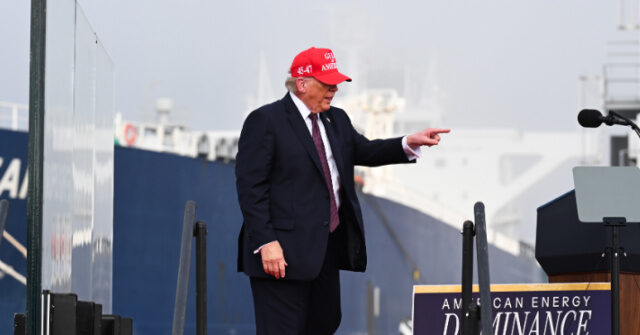
Former President Donald Trump recently addressed a gathering at the Port of Corpus Christi, Texas, asserting that his administration's energy policies were directly responsible for a significant increase in domestic oil and natural gas production, alongside a noticeable reduction in gasoline prices nationwide. Speaking to dock workers on a Friday, with the expansive Gulf of Mexico and numerous oil tankers forming a backdrop—including one reportedly carrying hundreds of thousands of barrels of crude—Trump championed what he characterized as a historic American energy boom. He specifically highlighted the growth in liquefied natural gas (LNG) exports as a key achievement, attributing these developments to strategic decisions implemented during his presidency. The former president's remarks aimed to draw a direct line between his policy directives and tangible economic advantages for American consumers and those employed within the energy sector, particularly in vital energy hubs such as Corpus Christi, a crucial port for energy exports.
During his address, former President Trump offered a retrospective on his administration's approach to energy policy, recalling his declaration of a national energy emergency on his first day in office. He claimed to have immediately reversed what he characterized as a 'Biden export ban,' a move he stated was pivotal in unleashing America's full energy potential. According to Trump, he issued a clear directive to energy workers in Texas, urging them to 'drill baby drill,' signaling a strong commitment to maximizing domestic resource extraction. This policy stance, he asserted, represented a significant departure from the approaches of previous administrations and established the foundation for the current energy landscape. The former president's narrative emphasized a proactive, deregulation-focused strategy designed to bolster energy independence and stimulate economic growth, particularly in regions like Corpus Christi, which plays a critical role in the nation's energy infrastructure.
Further elaborating on his administration's impact, Trump underscored his role in securing essential funding for the Port of Corpus Christi during his initial term. He contrasted this with claims that former President Joe Biden had subsequently attempted to curtail this financial support after taking office, framing the issue as an ongoing struggle for the nation's energy future. These statements, according to reports, sought to position his past actions as foundational for the port's success and current operational capacity. The former president's address also aimed to connect his policy decisions directly to the livelihoods of energy sector employees and the broader economic well-being of American families, particularly through the lens of affordable energy. His remarks consistently linked robust domestic production and export capabilities to national prosperity and strategic advantage.
Political observers and industry analysts note that the former president's address in Corpus Christi serves to reinforce a consistent message regarding energy policy that resonates strongly with a particular segment of the electorate. His emphasis on deregulation, increased domestic production, and energy independence aligns with a long-standing conservative platform that prioritizes economic growth and national security through robust fossil fuel extraction. The implications of such rhetoric extend beyond immediate economic claims, aiming to shape public discourse on the future direction of American energy. As the nation grapples with evolving energy demands and environmental considerations, the former president's narrative underscores a continued political divide on the optimal path forward, suggesting that energy policy will remain a central theme in upcoming political cycles and public debates. The speech also highlights the strategic importance of key energy infrastructure, like the Port of Corpus Christi, in national economic and geopolitical strategies.
In conclusion, former President Donald Trump's recent address at the Port of Corpus Christi reiterated his claims of having spearheaded a significant energy boom during his time in office, attributing increased production and lower gas prices to his administration's policies. His remarks, delivered against a backdrop of active energy infrastructure, underscored a commitment to maximizing domestic resource extraction and promoting energy exports, particularly LNG. The former president also highlighted his alleged efforts to secure funding for the port while criticizing his successor's purported attempts to reduce it. These statements collectively frame energy policy as a critical battleground for economic prosperity and national strength, setting the stage for continued debate on the nation's energy future and its broader economic implications.