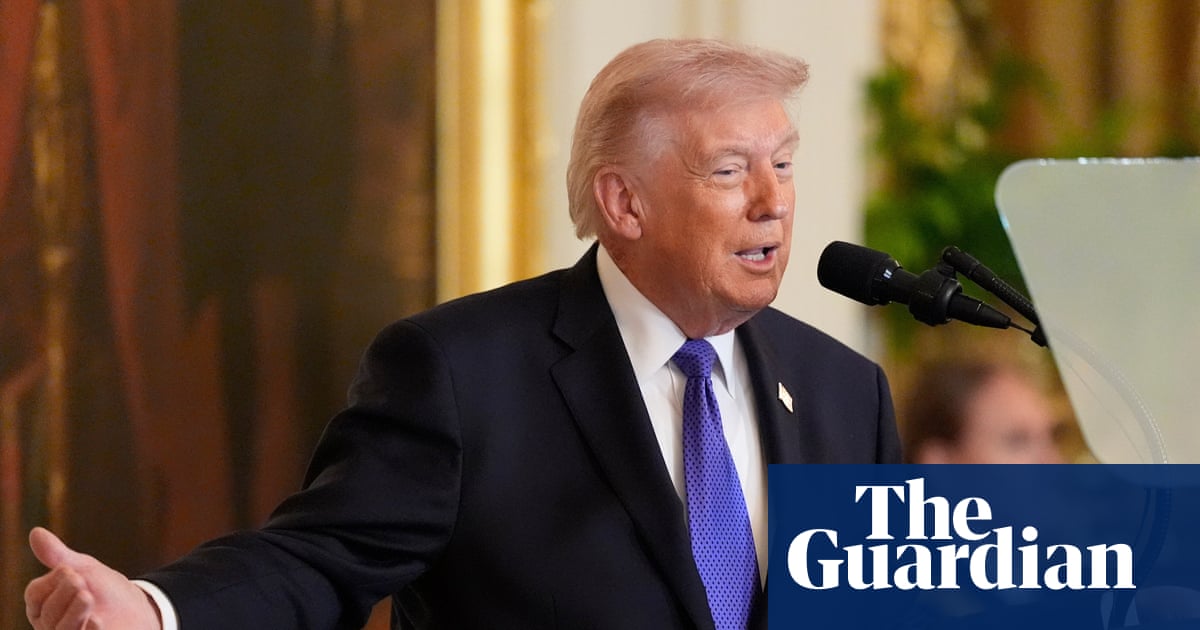
President Donald Trump offered his most comprehensive public statements to date regarding the United States' military campaign in Iran, outlining a projected duration of four to five weeks, while simultaneously cautioning that the engagement could potentially extend for a significantly longer period. Speaking on Monday, the President articulated four strategic objectives for the ongoing operation, which has been designated 'Operation Epic Fury.' These remarks represent a substantial expansion on his previous communications, which had largely consisted of brief video messages and a series of concise phone interviews with journalists, sometimes presenting varied aims. The President's address also served to justify a critical intervention conducted on Saturday, an action that, according to reports, resulted in the death of Iran's supreme leader, Ayatollah Ali Khamenei. His comments sought to provide clarity on the administration's strategy and rationale behind the heightened military posture in the region, addressing both immediate actions and future prospects for the conflict.
The context for President Trump's detailed comments stems from the recent escalation of tensions, culminating in Saturday's intervention that led to the death of Ayatollah Ali Khamenei, Iran's supreme leader. President Trump asserted that the primary motivation behind ordering the attack on Iran was to counteract what he described as Tehran's aggressive nuclear development and a ballistic missile program that was experiencing rapid and dramatic expansion. According to the President, this dual threat posed a 'very clear, colossal threat' not only to the United States homeland but also to American military personnel stationed across the globe. Furthermore, President Trump referenced a historical pattern of aggression by the Iranian regime, citing instances where it allegedly attacked American interests and caused casualties among US citizens, including through the deployment of roadside bombs. He characterized the current military action as the 'last best chance to strike,' underscoring the perceived urgency and necessity of the intervention.
During his extensive remarks, President Trump also took the opportunity to critique the previous administration's foreign policy regarding Iran. He expressed considerable pride in his decision to withdraw the United States from the Iran nuclear deal, a landmark agreement negotiated by former President Barack Hussein Obama. President Trump characterized this accord as a 'horrible, horrible, dangerous document,' contending that had it remained in effect, Iran would have possessed nuclear weapons approximately three years prior and would have subsequently utilized them. He emphatically stated his commitment to preventing such an outcome. Amidst these serious discussions, the President's address took an unexpected turn as he abruptly shifted focus to laud his plans for a new White House ballroom. He boasted that the forthcoming ballroom would be 'the most beautiful ballroom in the world,' completed 'under budget' and 'ahead of schedule,' with an estimated cost of '400 million dollars or less.' The sounds of construction work on this project were reportedly audible during the solemn Medal of Honor ceremony in the East Room, where the President delivered his remarks. He also dismissed criticisms suggesting he might become 'bored' with the conflict and disengage, asserting his resolve.
The President's assertion that Iran would soon develop missiles capable of reaching the United States, a claim he made without presenting supporting evidence, has been met with skepticism from national security experts who reportedly dispute its veracity. This particular claim, alongside his broader justifications for military action, highlights a significant point of contention in the ongoing debate surrounding US policy toward Iran. Furthermore, President Trump indicated that other nations privately supported American efforts to prevent Iran from acquiring nuclear weapons, but he suggested these countries 'just didn’t have the courage to say so' publicly. This statement offers a glimpse into the administration's perspective on international alliances and diplomatic dynamics in the region. The juxtaposition of discussing a potentially protracted military conflict with the details of a White House renovation project, complete with audible construction noise during a formal ceremony, has raised questions about the administration's messaging and the perceived gravity of the situation. Analysts suggest such a pivot could impact how both allies and adversaries interpret the seriousness of the US commitment and strategic focus.
In summary, President Trump's recent comments represent a pivotal moment in the public discourse surrounding the US military campaign in Iran, offering the most detailed insights into the administration's strategy and expectations. While projecting a relatively short initial duration of four to five weeks for 'Operation Epic Fury,' the President's caveat that the conflict could extend 'far longer' underscores the inherent uncertainties and potential for prolonged engagement. His justifications for the intervention, rooted in thwarting Iran's nuclear and ballistic missile ambitions and addressing historical grievances, frame the administration's rationale. However, the inclusion of unsubstantiated claims and the unusual digression into White House renovation plans during a serious address have introduced complexities into the public's understanding of the situation. Moving forward, observers will closely monitor the actual trajectory of the conflict, international reactions to the US stance, and any further substantiation or refutation of the President's claims, as the region remains a focal point of global security concerns.