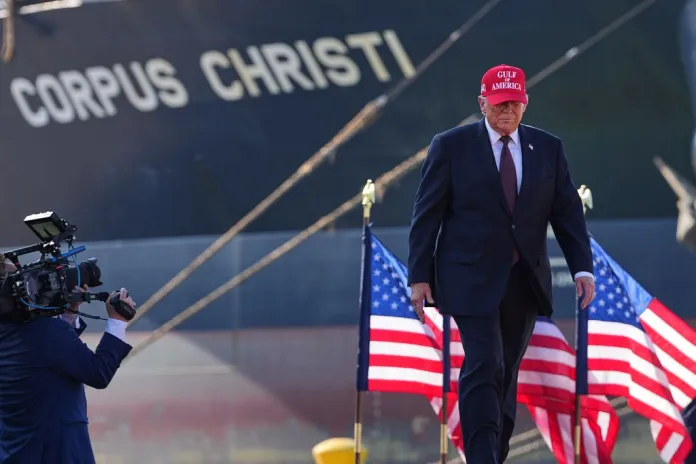
Following the confirmed death of Iran's Supreme Leader Ali Khamenei in an Israeli strike, former U.S. President Donald Trump has indicated he has specific individuals in mind as potential future leaders for the Islamic Republic. Reports confirm Khamenei's compound was targeted on Saturday, bringing an end to his extensive 36-year tenure and plunging the Iranian regime into a period of significant uncertainty regarding its succession. As joint military operations by the United States and Israel persist across the region, the question of who will govern Iran has become paramount. During an interview conducted late Saturday, Trump was directly asked about his preferences for Khamenei's successor, to which he reportedly replied, "Yes, I think so," adding that there are "some good candidates." He further asserted his precise knowledge of who is currently managing Iran's affairs in the immediate aftermath of Khamenei's demise, though he chose not to disclose these names publicly. These remarks from the former U.S. president underscore a potential desire for external influence over Iran's future political landscape, coming at a time when Tehran is grappling with the sudden vacuum at the pinnacle of its leadership.
The abrupt end of Supreme Leader Ali Khamenei's nearly four-decade rule marks a pivotal moment in Iran's modern history, fundamentally altering the geopolitical landscape of the Middle East. Khamenei, who assumed the role of Supreme Leader in 1989 after the death of Ayatollah Ruhollah Khomeini, wielded ultimate authority over all major state policies, military, and judicial decisions, shaping Iran's domestic and foreign policy for generations. His passing, attributed to an Israeli strike on his compound, has not only created an immediate power vacuum but also intensified the ongoing regional tensions, particularly given the continuation of joint U.S. and Israeli military actions. These operations, which began overnight prior to Trump's public statements, have been accompanied by discussions from figures like Trump and Israeli Prime Minister Benjamin Netanyahu, who reportedly floated the concept of regime change in Iran. This suggests a broader strategic objective beyond targeted strikes, aiming to fundamentally alter the nature of governance in Tehran. The demise of such a long-reigning and influential figure inevitably ushers in a period of profound instability and strategic recalculation for both Iran and international actors invested in the region's future.
In the wake of Khamenei's death, the immediate governance of Iran has fallen to a provisional three-member council in Tehran, according to official reports. This council comprises Iranian President Masoud Pezeshkian, who notably survived an earlier Israeli targeting attempt, Chief Justice Gholam Hossein Mohseni Ejehi, and an unnamed prominent Islamic cleric. Their primary responsibility is to maintain state functions until a permanent successor is chosen. The crucial task of electing the next Supreme Leader will ultimately rest with Iran's Assembly of Experts, an influential body composed of 88 elected Islamic clerics. While this internal process unfolds, external figures continue to weigh in on Iran's future. Reza Pahlavi, the former crown prince whose family governed Iran before the 1979 revolution, has emerged as a prominent opposition voice, previously expressing his readiness to lead any transitional government. Following Khamenei's death, Pahlavi asserted that the Islamic Republic's era was concluding, predicting its swift consignment "to the dustbin of history" and declaring that any chosen successor would be "doomed to fail." Despite Pahlavi's vocal stance and historical lineage, former President Trump has reportedly shown noticeable hesitation in publicly endorsing him, leaving the path for a potential democratic transition in Iran highly uncertain.
The former U.S. President's assertion of knowing "good candidates" for Iran's leadership, coupled with his and Prime Minister Netanyahu's earlier discussions of regime change, introduces a complex layer of external influence into an already volatile internal succession crisis. This posture could be interpreted as an attempt to shape the narrative and potentially the outcome of Iran's leadership transition, signaling a proactive stance from Washington and Tel Aviv. The challenge of establishing a stable, democratic future for Iran is immense, particularly given the deep-seated structures of the Islamic Republic and the historical context of the 1979 revolution. While figures like Reza Pahlavi offer a vision of a post-theocratic state, the lack of a clear endorsement from key international players like Trump, as reported, highlights the significant hurdles and divergent interests at play. Experts suggest that the Assembly of Experts, despite its clerical composition, will face immense pressure to select a leader who can navigate both internal factionalism and intense external scrutiny, all while maintaining the integrity of the state amidst ongoing military operations. The viability of a swift, peaceful transition to a more democratic system remains highly questionable, with many analysts pointing to the potential for prolonged instability or even internal conflict as various factions vie for control.
The death of Supreme Leader Ali Khamenei marks an unprecedented turning point for Iran, triggering a period of profound uncertainty and potential transformation. With joint U.S. and Israeli strikes continuing and a provisional council currently governing, the nation stands at a critical juncture. Former President Donald Trump's remarks about having preferred candidates for Iran's future leadership underscore the international community's keen interest and potential desire to influence the succession process. As the Assembly of Experts prepares to convene and select the next Supreme Leader, the world will be closely watching for signs of internal stability, the direction of the new leadership, and the broader implications for regional security. The coming weeks will be crucial in determining whether Iran moves towards a more open future, as envisioned by some opposition figures, or entrenches itself further in its existing political framework amidst ongoing external pressures and internal power struggles.