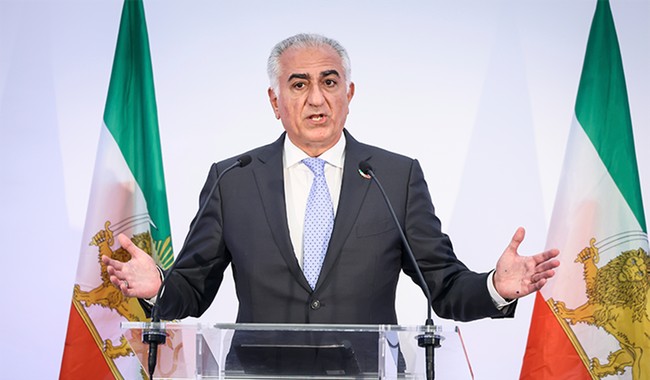
In a significant development amidst escalating regional tensions, Iran's exiled Crown Prince, Reza Pahlavi, has publicly expressed strong approval for recent joint military operations conducted by the United States and Israel targeting the Islamic Republic. According to reports emerging over the weekend, Pahlavi characterized these strategic assaults as a form of 'aid' and a 'humanitarian intervention,' specifically attributing their orchestration to former President Donald Trump. His statements were made on a Saturday, coinciding with widespread reports indicating that elements of the Iranian leadership were actively attempting to evade American and Israeli aerial bombardments. This endorsement from the heir to the former Iranian throne underscores a complex geopolitical dynamic, where an exiled figure openly supports foreign military action against the current government of his homeland, framing it as a beneficial act for the Iranian populace rather than an act of aggression. The timing of Pahlavi's remarks, directly following these reported military engagements, highlights the immediate and vocal nature of his support for the coalition's actions.
Reza Pahlavi, the eldest son of the late Mohammad Reza Pahlavi, the last Shah of Iran, has lived in exile since the 1979 Islamic Revolution overthrew the monarchy and established the current Islamic Republic. As the titular head of the former imperial house, he represents a prominent voice of opposition to the clerical regime, advocating for a secular, democratic Iran. His public endorsement of US and Israeli military actions carries considerable symbolic weight, signaling a belief among some exiled opposition figures that external pressure, even military force, could serve the interests of the Iranian people by weakening the current government. The historical context of his family's rule, which saw close ties with the United States, provides a backdrop for understanding his perspective, contrasting sharply with the anti-Western stance of the present Iranian government. This alignment with American and Israeli strategic objectives against Tehran underscores the deep ideological chasm between the exiled monarchy and the ruling establishment, further complicating the already volatile political landscape of the Middle East.
Following the reported military engagements, the exiled Crown Prince issued a declaration further solidifying his stance. This declaration, according to sources, elaborated on his view that the strikes were not merely punitive but served a broader purpose of assisting the Iranian populace. The specific characterization of these actions as 'humanitarian intervention' is particularly noteworthy, as it reframes military force through a lens of aid and liberation, a perspective often debated in international law and ethics. Reports indicated that the joint American and Israeli aerial assaults were significant enough to compel Iranian leadership figures to take evasive measures, suggesting a substantial impact on the ground. Pahlavi's direct attribution of these operations to President Donald Trump is also a critical detail, potentially linking the actions to a specific political administration and its foreign policy approach towards Iran, which has historically been characterized by a 'maximum pressure' campaign. These details collectively paint a picture of a calculated and vocal endorsement, aimed at influencing both international perception and potentially galvanizing internal dissent within Iran.
The implications of an exiled leader praising foreign military actions against his home country's government are multifaceted and could significantly impact the ongoing geopolitical discourse surrounding Iran. From an analytical perspective, Pahlavi's statements could be interpreted as an attempt to legitimize external military pressure by framing it as a necessary step towards regime change or internal reform, aligning with the aspirations of a segment of the Iranian diaspora. Experts suggest that such endorsements, while potentially bolstering the morale of opposition movements, also risk being exploited by the current Iranian government to portray the opposition as foreign-backed and disloyal. Furthermore, the use of terms like 'humanitarian intervention' in the context of military strikes raises questions about the criteria and justifications for such actions, particularly when articulated by a non-state actor with a vested interest in the country's political future. This narrative could also influence international perceptions of US and Israeli actions, potentially garnering support from those who view the Iranian regime as oppressive, while simultaneously drawing criticism from those who oppose military intervention as a solution to political conflicts.
In conclusion, Reza Pahlavi's public commendation of recent US and Israeli military strikes against Iran, framing them as 'humanitarian aid' orchestrated by Donald Trump, represents a notable development in the complex narrative surrounding the Islamic Republic. His statements, issued from exile, underscore the deep divisions between the current Iranian government and its historical opposition, while also highlighting the controversial nature of foreign military intervention. As tensions persist in the region, the role of exiled figures like Pahlavi in shaping international discourse and influencing perceptions of military actions will remain a critical aspect to monitor. The coming period will likely see continued scrutiny of US and Israeli strategies towards Iran, the Iranian government's responses, and the evolving dynamics of internal and external pressures on the regime, all against the backdrop of these highly charged pronouncements from the former royal heir.