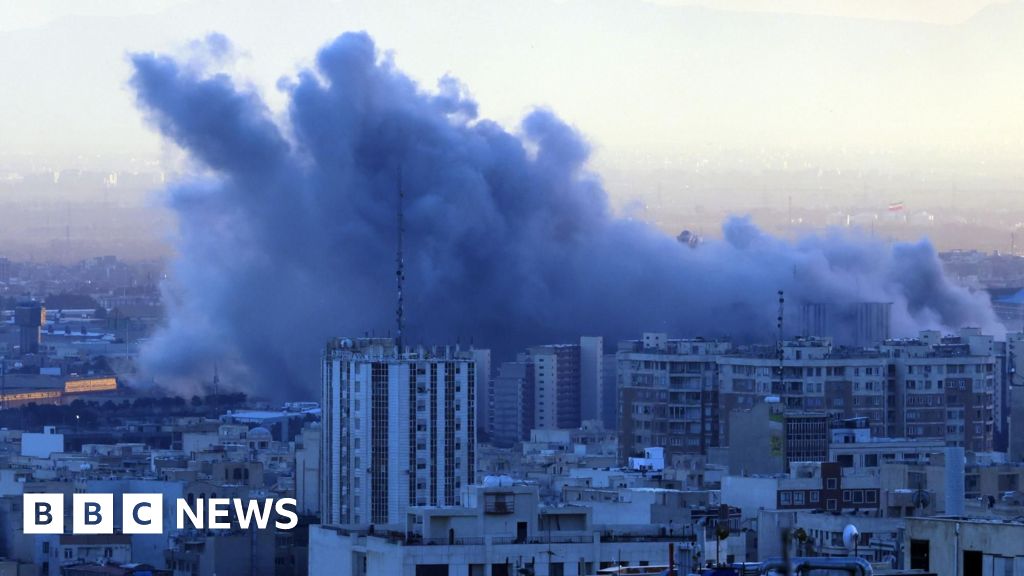
A significant escalation in Middle Eastern tensions continues as United States and Israeli forces have reportedly conducted a fourth consecutive day of aerial bombardments across Iran. President Donald Trump issued a stark declaration regarding the Islamic Republic's military capabilities, asserting that its air defenses, air force, naval power, and even its leadership structures have been neutralized. Reports from the Israeli military indicate that their operations specifically targeted Iran's presidential office, a clandestine nuclear facility, and a senior Revolutionary Guards commander within Tehran. Concurrently, the US military confirmed its involvement in destroying various command centers, missile launch sites, and airfields. This intense period of military action has tragically resulted in widespread casualties, with the Iranian Red Crescent reporting 780 fatalities since the initial strikes commenced on Saturday, alongside numerous explosions documented throughout the country. In response, Iranian forces have launched their own deadly missile and drone attacks against both Israel and several Gulf states hosting American military installations, signaling a dangerous cycle of retaliation.
The current wave of hostilities marks a dramatic intensification of long-standing geopolitical friction in the region, originating with a joint US-Israeli offensive launched on Saturday. That initial assault proved particularly devastating, reportedly resulting in the deaths of Iran's Supreme Leader, Ayatollah Ali Khamenei, and several other high-ranking officials. This unprecedented targeting of Iran's top leadership immediately signaled a profound shift in the conflict's dynamics. Historically, tensions between the US and Iran have revolved around Tehran's nuclear ambitions, its development of ballistic missile technology, and its extensive support for various proxy groups across the Middle East, which Washington and its allies view as destabilizing. Israel, for its part, has consistently voiced grave concerns over Iran's nuclear program and its military presence near Israeli borders. The current strikes, and the subsequent Iranian retaliation, underscore the deep-seated animosities and the precarious balance of power in a region already prone to volatility.
Further details emerging from the ongoing conflict highlight the specific nature of the military engagements. The Israeli military detailed its precision strikes against critical Iranian infrastructure, including what it described as a covert nuclear compound, a Revolutionary Guards commander's location in Tehran, and the nation's presidential office. Simultaneously, the US military confirmed its focus on dismantling key operational assets, such as command facilities, missile launch sites, and airfields, aiming to cripple Iran's capacity for military response. While Iranian authorities have refrained from issuing official comments on the attacks, local reports confirm widespread explosions across the country, corroborating the severity of the sustained aerial campaign. Iran's retaliatory actions have been swift and geographically diverse; on Tuesday evening, a drone struck a parking area adjacent to the US consulate in Dubai, igniting a fire, a development confirmed by US Secretary of State Marco Rubio. Hours prior, two drones reportedly impacted the US embassy in Saudi Arabia's capital, Riyadh, causing a limited blaze, according to statements from the Saudi defense ministry. These counter-attacks underscore the widening scope of the conflict, drawing in regional allies and US interests.
The audacious nature of President Trump's declaration that Iran's military capabilities and leadership are "gone" carries significant analytical weight, potentially serving as both a psychological tactic and an indicator of the perceived success of the allied strikes. This assertion, if accurate, would represent a monumental shift in the regional power balance, though its full veracity remains to be independently verified given the lack of official Iranian response. The direct targeting of Iran's Supreme Leader in the initial assault, combined with the subsequent strikes on presidential and nuclear facilities, signals an unprecedented level of aggression and a clear intent to dismantle the core elements of Iran's state power and military infrastructure. Experts suggest that such actions dramatically heighten the risk of a broader regional conflagration, especially with Iran's demonstrated capacity for retaliatory strikes against US and allied targets in the Gulf. The involvement of Saudi Arabia and the UAE, hosting critical US assets, underscores the precarious position of regional stability and the potential for the conflict to engulf more nations, leading to severe humanitarian and economic consequences.
As the US and Israel continue their fourth day of military operations against Iran, the situation remains critically volatile, marked by significant casualties and a dangerous cycle of reciprocal attacks. President Trump's sweeping claims about Iran's neutralized military capabilities, coupled with the precision targeting of high-value Iranian assets, underscore the intensity of the current conflict. Iran's measured but effective retaliatory strikes against US interests in allied Gulf states demonstrate its intent to respond forcefully, even without official statements. The international community now watches closely for further escalation, considering the profound implications for regional stability and global energy markets. The immediate future will likely be shaped by whether diplomatic channels can be opened, or if the current trajectory of military confrontation will continue to deepen, potentially leading to a full-scale regional war with devastating consequences for millions.