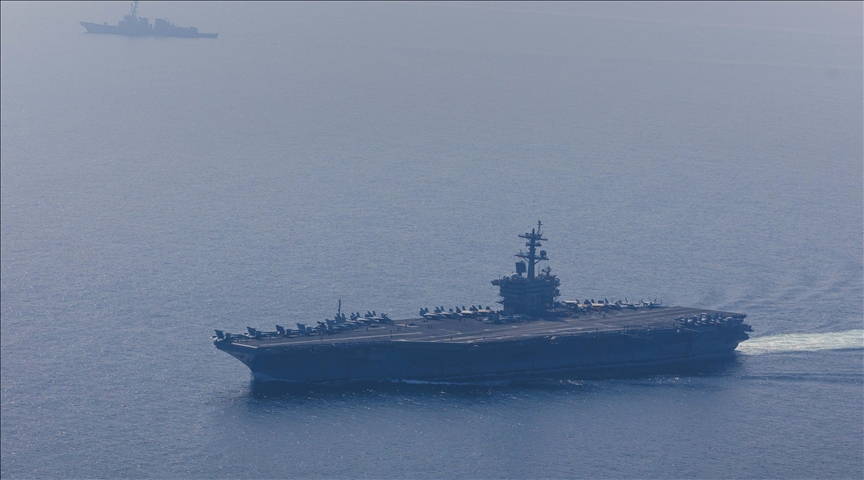
In a significant development amidst ongoing regional tensions, the United States has categorically denied claims originating from Iran suggesting that its Nimitz-class aircraft carrier, the USS Abraham Lincoln, was struck by ballistic missiles. Reports from Anadolu Ajansı indicate that US authorities swiftly moved to counter the assertion, which, if true, would represent an unprecedented and severe escalation in the already fraught relationship between Washington and Tehran. The denial underscores the volatile information environment prevalent in the Middle East, where unverified claims can quickly circulate and potentially exacerbate geopolitical friction. The USS Abraham Lincoln, a cornerstone of American naval power projection, frequently operates in strategically vital waterways, including those adjacent to Iran, making it a recurring subject in regional narratives concerning military posturing and perceived threats. The swiftness of the US rebuttal highlights the critical importance placed on controlling narratives and preventing misinformation from gaining traction in a region perpetually on edge.
The backdrop to this denial is a long-standing and often contentious relationship between the United States and Iran, marked by periods of intense diplomatic strain and occasional military confrontations. The Persian Gulf and surrounding waters are crucial for global energy trade, and the presence of US naval assets, including carrier strike groups like the one led by the USS Abraham Lincoln, is a consistent feature of regional security architecture. These deployments are often framed by Washington as vital for maintaining stability and deterring aggression, while Tehran frequently views them as a provocative military presence. Historical flashpoints, such as incidents involving shipping in the Strait of Hormuz or drone engagements, have repeatedly demonstrated the potential for rapid escalation. In this environment, any claim of a direct attack on a major US warship carries immense weight, necessitating immediate and authoritative responses from all involved parties to manage perceptions and prevent miscalculation. The strategic significance of an aircraft carrier, capable of launching dozens of fighter jets and housing thousands of personnel, makes it a potent symbol of military might and a high-value target in any conflict scenario.
According to reports, the Iranian claim specifically referenced a strike by ballistic missiles against the USS Abraham Lincoln. Such an event, had it occurred, would constitute an act of war and a dramatic escalation far beyond previous incidents in the region. Ballistic missiles, known for their speed and destructive potential, represent a significant threat to naval vessels, and a successful strike on an aircraft carrier would have profound implications for maritime security and global stability. However, US officials, as reported, have maintained that the claim is entirely unfounded, providing no corroborating evidence for the alleged incident. The absence of any independent verification, coupled with the definitive US denial, casts significant doubt on the veracity of the Iranian assertion. In the realm of international relations, particularly in tense regions, state-sponsored media or official statements can sometimes be used to project strength, test reactions, or influence public opinion, even if the underlying claims lack factual basis. The immediate and unequivocal nature of the US denial serves as a direct counter-narrative, aiming to neutralize the impact of such assertions and reaffirm the operational integrity of its naval forces.
Analysts observing the dynamics of US-Iran relations suggest that claims of this nature often serve multiple purposes within the broader context of information warfare. From Tehran's perspective, such assertions, even if unverified, could be intended to project an image of military capability and resolve, potentially aiming to deter perceived adversaries or bolster domestic support. It could also be a tactic to test the international community's reaction or gauge the US response. Conversely, the swift and firm denial from Washington is crucial for maintaining credibility, reassuring allies, and preventing panic or misinterpretation that could destabilize the region further. Experts emphasize the critical role of accurate and verified information in preventing accidental escalation, especially in areas where military forces operate in close proximity. The incident underscores the ongoing challenge of distinguishing fact from propaganda in a highly politicized environment, where narratives can be weaponized to achieve strategic objectives without direct military engagement. The potential for miscalculation remains a constant concern, making official communication and transparent reporting paramount.
The US denial of the Iranian claim regarding a ballistic missile strike on the USS Abraham Lincoln serves as a stark reminder of the persistent tensions and the complex information landscape characterizing the relationship between the two nations. While the immediate threat implied by the Iranian assertion has been dismissed by US authorities, the incident highlights the continuous need for vigilance and clear communication in a volatile region. Moving forward, observers will continue to monitor official statements from both Washington and Tehran, as well as independent reporting, for any further developments or shifts in rhetoric. The operational status and movements of US naval assets in the Middle East will also remain under close scrutiny, as will any attempts by regional actors to disseminate unverified claims. The episode underscores the imperative for all parties to exercise restraint and prioritize de-escalation in an environment where misinformation can have real-world consequences for peace and security.