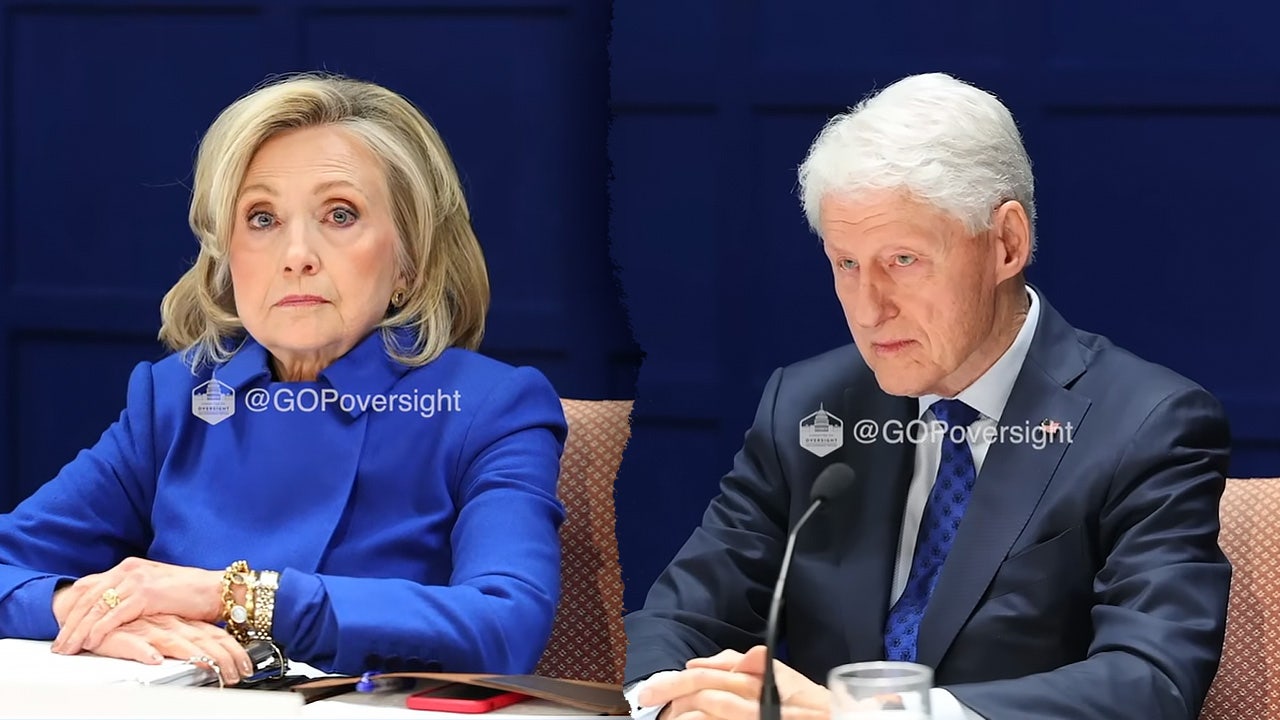
Former President Bill Clinton and former Secretary of State Hillary Clinton presented markedly different perspectives to House lawmakers last week when questioned about the potential testimony of former President Donald Trump in the ongoing Jeffrey Epstein investigation, according to newly released video footage. Both prominent political figures appeared before the House Oversight Committee in a closed-door session, which spanned several hours and took place in their hometown of Chappaqua, New York. During these proceedings, representatives from the Democratic side of the committee specifically inquired whether Trump should be compelled to testify, given his publicly acknowledged prior associations with the late financier and convicted sex offender. Hillary Clinton unequivocally responded with 'Absolutely' when posed the question by Democratic staff, while Bill Clinton adopted a more reserved and non-committal stance, leaving the decision to the committee itself. This clear divergence in their positions on a highly sensitive and politically charged matter has drawn significant attention, highlighting the complexities surrounding the probe into Epstein's network.
The House Oversight Committee's inquiry into Jeffrey Epstein's activities and his extensive network represents a significant effort to understand the full scope of his illicit operations and the individuals connected to him. Epstein, who was a prominent figure in financial and social circles, faced charges related to sex trafficking and ultimately died in federal custody in 2019. The ongoing investigation seeks to shed light on the circumstances surrounding his crimes and the potential involvement or knowledge of others. Public interest in the Epstein case remains high, fueled by a desire for accountability and transparency regarding those who associated with him. The committee's decision to question high-profile individuals like the Clintons underscores the broad reach and serious nature of this probe, aiming to piece together a comprehensive picture of Epstein's connections and activities, particularly concerning any individuals who may have had significant interactions with him.
During her testimony, Hillary Clinton provided a detailed rationale for her assertion that Donald Trump should be called to testify. She referenced the civil case brought by writer E. Jean Carroll, in which Trump was found civilly liable for defamation following Carroll's allegations of sexual assault, as well as the 34-count criminal conviction in New York City related to alleged payments to adult film star Stormy Daniels. While acknowledging that neither of these legal matters directly pertained to the Epstein investigation, former Secretary Clinton contended that they collectively demonstrated a 'pattern' of behavior relevant to the committee's scope. She further elaborated, stating, 'I think that it would be in keeping with the scope of the investigation of this committee to set up a deposition with President Trump.' Clinton also noted Trump's history of numerous depositions and his frequent invocation of the Fifth Amendment, suggesting that while extensive information might not be forthcoming, his inclusion on a witness list would be justified 'given what's in the files, and given past and prior conduct.' In stark contrast, Bill Clinton's response to the same question, posed by Rep. Robert Garcia, D-Calif., the committee's leading Democrat, was notably more circumspect. The former president refrained from endorsing or opposing the idea of Trump's testimony, instead stating, 'That's for you to decide.' He did, however, acknowledge that Trump 'did know him well' and mentioned having had 'a brief discussion with him about it' at one point, offering a more neutral and less prescriptive stance than his wife.
The divergent responses from the Clintons regarding Donald Trump's potential testimony in the Epstein probe carry significant implications, both politically and in terms of the investigation's trajectory. Hillary Clinton's assertive call for Trump's deposition, leveraging unrelated legal outcomes to suggest a 'pattern' of behavior, could be interpreted as a strategic move to broaden the scope of accountability and maintain pressure on a political rival. Her willingness to connect disparate legal challenges under a broader behavioral umbrella signals a robust approach to public scrutiny. Conversely, Bill Clinton's more measured and deferential stance, leaving the decision to the committee, suggests a cautious approach. His acknowledgment of Trump's familiarity with Epstein, coupled with his neutrality on testimony, could be seen as an attempt to avoid direct political confrontation while still providing relevant information. This contrast underscores the different political calculations and personal philosophies at play, potentially reflecting varying assessments of how best to navigate such a sensitive and high-stakes inquiry without overstepping or appearing overly partisan, while still contributing to the investigative process.
The newly revealed video footage of the Clintons' testimonies underscores a clear division within the prominent political couple regarding the parameters and focus of the House's Jeffrey Epstein investigation. While Hillary Clinton advocated strongly for Donald Trump's testimony, citing a broader behavioral pattern from unrelated legal cases, Bill Clinton maintained a neutral position, deferring to the committee's judgment while confirming Trump's acquaintance with Epstein. This divergence highlights the ongoing political sensitivities surrounding the Epstein probe and the complex web of associations it seeks to unravel. As the House Oversight Committee continues its work, the question of whether to compel Trump's testimony remains open, potentially influenced by these high-profile opinions. Observers will be watching closely to see if Hillary Clinton's forceful argument gains traction and how the committee ultimately decides to proceed in its pursuit of understanding the full extent of Epstein's network and those connected to it.