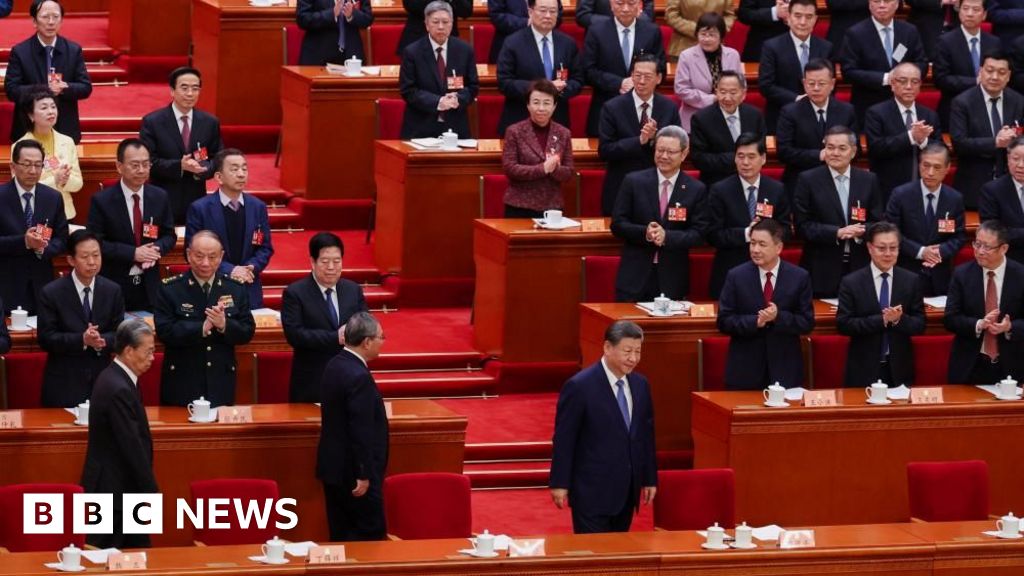
China's most significant annual political assembly, widely referred to as the "two sessions," has begun this week, setting the stage for crucial policy discussions that will shape the trajectory of the world's second-largest economy. This carefully orchestrated gathering comprises two distinct but interconnected meetings: the advisory body, the Chinese People's Political Consultative Conference (CPPCC), which convened on Wednesday, and the National People's Congress (NPC), the nation's top legislative body, scheduled to commence on Thursday. Typically spanning one to two weeks, these sessions are closely monitored by international observers for insights into Beijing's strategic priorities, particularly regarding its economic growth ambitions amidst challenges in boosting domestic consumption. A key focus will be the unveiling of the new Five Year Plan, expected to outline President Xi Jinping's comprehensive roadmap for the country's development. The proceedings unfold against a backdrop of recent high-profile dismissals of military officials, reportedly part of President Xi's ongoing anti-corruption efforts, adding another layer of scrutiny to the event.
The "two sessions" collectively represent China's most prominent political event of the year, a meticulously planned spectacle designed to project national unity and policy direction. The Chinese People's Political Consultative Conference (CPPCC), the first of the two bodies to meet, functions as a key advisory institution. Its membership, exceeding 2,000 individuals, is diverse, drawing representatives from various societal sectors beyond just the Communist Party. While the CPPCC's discussions offer valuable insights into prevailing policy debates and societal concerns, it does not possess legislative authority. That power is technically vested in the National People's Congress (NPC), which follows the CPPCC. The NPC is often described by external analysts as a largely ceremonial or "rubber-stamp" legislature, implying that its primary role is to endorse decisions already made by the Communist Party leadership, rather than to engage in independent legislative deliberation or challenge executive authority. This structured approach underscores the centralized nature of China's political system and the importance of these meetings in formalizing the Party's agenda.
As the "two sessions" unfold, global analysts are particularly keen to discern China's economic targets for the upcoming year, especially given the current domestic landscape. Reports indicate that the nation has been grappling with efforts to stimulate internal consumption, a critical component for sustainable economic expansion. Despite these headwinds, observers will be watching closely to see if Beijing opts for ambitious growth projections, signaling a strong commitment to economic expansion even in challenging circumstances. A cornerstone of the meetings will be the presentation of the new Five Year Plan, a pivotal document that traditionally serves as President Xi Jinping's strategic blueprint, detailing the nation's overarching development goals and policy directives across various sectors for the medium term. Furthermore, the political atmosphere surrounding these sessions is notably influenced by recent high-level changes within the military leadership. Several senior military officials have reportedly been removed from their positions, a development widely understood to be part of President Xi's extensive and long-running anti-corruption campaign, which has consistently targeted officials across various state apparatuses.
The carefully choreographed nature of the "two sessions" offers a window into the current state of Chinese governance and the consolidation of power under President Xi Jinping. The unified messaging and pre-determined outcomes, characteristic of these gatherings, underscore the Communist Party's firm control over policy formulation and implementation, leaving little room for public dissent or significant legislative challenges. The emphasis on economic strategy, particularly the new Five Year Plan, signals China's determination to navigate global economic uncertainties and continue its trajectory towards becoming a leading economic power. The decisions made here will have profound implications not only for China's domestic population but also for international trade, investment, and geopolitical dynamics. The recent purges within the military, while framed as anti-corruption measures, also highlight President Xi's ongoing efforts to reinforce loyalty and discipline within key state institutions, ensuring that the armed forces align unequivocally with the Party's objectives. This continuous consolidation of power is a central theme that international observers will be analyzing for its long-term impact on China's political stability and future direction.
In conclusion, China's annual "two sessions" represent far more than routine parliamentary meetings; they are a meticulously managed political spectacle that offers critical insights into the nation's strategic direction and leadership priorities. From the economic growth targets that will shape global markets to the detailed roadmap laid out in the new Five Year Plan, the outcomes of these gatherings will resonate both domestically and internationally. The backdrop of military purges further underscores President Xi Jinping's unwavering commitment to consolidating power and maintaining internal stability through his anti-corruption drive. As the sessions progress over the next one to two weeks, observers will continue to scrutinize official statements and policy announcements for concrete details on how China plans to address its economic challenges, particularly regarding domestic consumption, and to understand the nuances of its long-term development strategy. The resolutions adopted here will serve as a definitive guide to Beijing's agenda for the coming year and beyond.