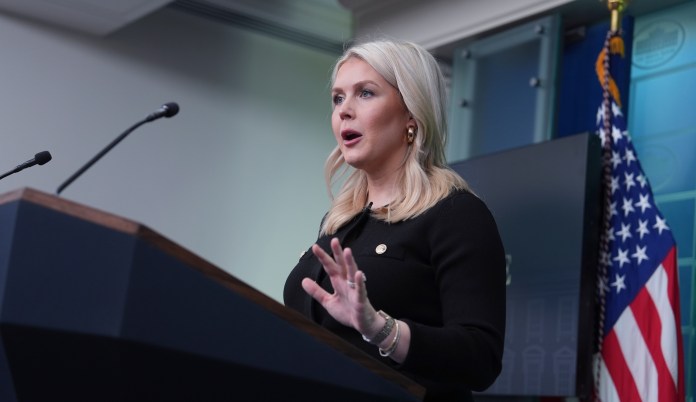
The White House is actively engaged in an effort to resolve internal dissent among conservative commentators who have voiced strong objections regarding the Trump administration's communication strategy concerning its military actions against Iran. Reports indicate that White House press secretary Karoline Leavitt issued a comprehensive statement on Monday, aiming to defend the president against accusations that his administration's justifications for the ongoing conflict have been both vague and, at times, contradictory. This move comes in the wake of a recent military strike that resulted in the death of senior Iranian leadership, prompting a wave of questions from within the administration's own ideological allies. The core of the criticism centers on perceived inconsistencies in defining the objectives of the operation, leading to what some describe as a 'mutiny' on the political right, demanding greater clarity and coherence from the nation's leadership on a critical foreign policy matter.
The internal 'mutiny' on the Right, as described by some observers, escalated following a Saturday strike that eliminated key Iranian figures. Prominent conservative voices, including commentator Matt Walsh, a known supporter of the Trump administration, publicly challenged the White House's reluctance to explicitly label the operation as a pursuit of 'regime change,' especially given the high-profile casualties among Iran's senior leadership. Walsh further highlighted what he perceived as conflicting narratives from President Trump and his senior advisors regarding the nature of the strikes. While President Trump initially characterized the Iranian threat as 'imminent' on Saturday, a description that typically implies a preemptive strike, administration officials subsequently appeared to temper this assertion. Moreover, Walsh questioned the administration's renewed emphasis on dismantling Iran's nuclear program as a primary objective, pointing out that officials had previously stated that Iran's nuclear facilities were 'obliterated' in the preceding year, creating a significant discrepancy in stated policy goals.
In response to the growing conservative outcry, White House press secretary Karoline Leavitt released a detailed statement on Monday, primarily focused on defending the president's approach and clarifying the administration's objectives. While her statement did not directly address whether the Trump administration was pursuing regime change in Iran – a goal President Trump himself had alluded to in recent public remarks – it unequivocally identified the destruction of Iran's military capabilities and its associated terrorist proxies as key aims of the operation. Leavitt further reinforced this stance through a sharply worded post on X, where she asserted, "Killing terrorists is good for America," underscoring the administration's perceived moral and strategic imperative. This clarification sought to streamline the administration's public narrative, even as it navigated the complexities of previous statements, including the President's initial characterization of an 'imminent' threat and the evolving explanations surrounding the status of Iran's nuclear infrastructure.
The current efforts by the White House to consolidate its messaging underscore the critical importance of clear and consistent communication in foreign policy, particularly during periods of military engagement. Analysts suggest that internal disagreements and perceived policy ambiguities, even among political allies, can undermine public confidence, both domestically and internationally. For the Trump administration, navigating this conservative backlash presents a delicate balancing act: satisfying a base that may favor more aggressive action, potentially including regime change, while maintaining a public stance that aligns with broader strategic objectives and avoids escalating regional tensions unnecessarily. Experts in strategic communication emphasize that a unified narrative is essential for projecting strength and resolve, and any perceived 'confusion' can be exploited by adversaries or lead to misinterpretations of intent, potentially complicating future diplomatic or military endeavors. The challenge lies in articulating a coherent strategy that resonates with diverse audiences while remaining adaptable to rapidly evolving geopolitical realities.
In summary, the White House is actively working to quell a significant wave of criticism from conservative commentators regarding its communication strategy on military operations in Iran. The administration, through Press Secretary Karoline Leavitt, has sought to clarify its objectives, emphasizing the targeting of Iran's military and terrorist proxies, while sidestepping direct confirmation of regime change as a goal. This comes amidst persistent questions about the consistency of statements regarding the preemptive nature of strikes and the status of Iran's nuclear program. Moving forward, observers will be closely watching how effectively the White House can unify its messaging and whether these efforts will satisfy its conservative allies. The clarity of the administration's stance on Iran will undoubtedly have profound implications for both domestic political cohesion and the broader trajectory of US-Iran relations.