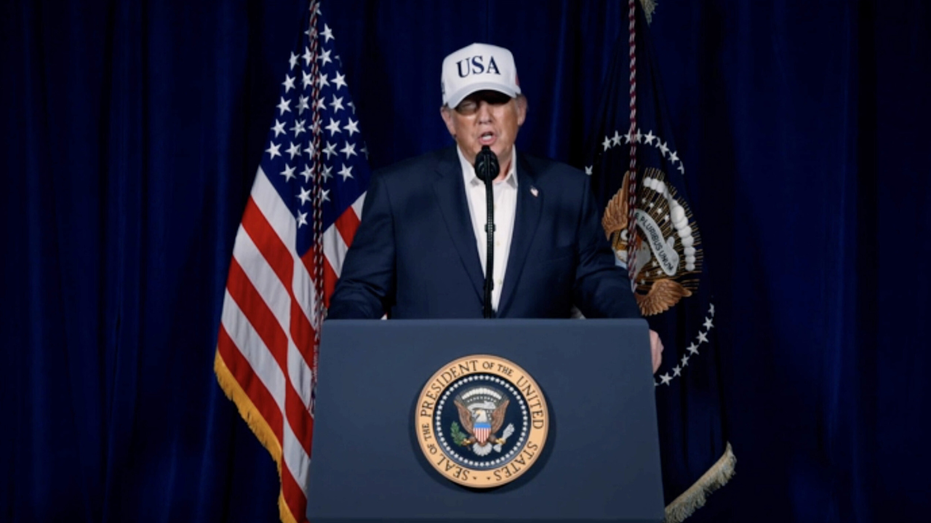
In a dramatic escalation of tensions in the Middle East, President Donald Trump, in conjunction with Israeli forces, reportedly launched a significant bombing campaign against Iran. This decisive military action culminated in the death of Iran's Supreme Leader, Ayatollah Ali Khamenei, an event described by sources as a remarkable military accomplishment. Following these precision strikes, President Trump notably employed the term 'regime change,' a phrase laden with historical resonance and significant implications for future U.S. foreign policy. This development has overshadowed other pressing domestic issues, including ongoing discussions about tariff policies and the aftermath of a recent Supreme Court ruling, shifting the global focus squarely onto the volatile situation in Iran and the potential for profound geopolitical shifts. The invocation of such strong rhetoric signals a potentially radical departure from previous U.S. strategies concerning the Islamic Republic, raising questions about the ultimate objectives of the current administration's approach.
The current administration's pivot to 'regime change' marks a significant evolution from its previously stated objectives regarding Iran. Just nine months prior, President Trump had claimed success in neutralizing Iran's nuclear ambitions following a surprise attack on underground nuclear facilities in Tehran. However, the recent rhetoric suggests a broader, more ambitious goal beyond merely containing Iran's nuclear program. The phrase 'regime change' itself carries a heavy historical weight, echoing the language used by former President George W. Bush two decades ago in the lead-up to the Iraq War. Bush's stated aim was to depose Saddam Hussein, a departure from his father's more limited objectives, and was predicated on what later proved to be fictional claims of weapons of mass destruction. This historical parallel underscores the gravity of President Trump's recent pronouncements and raises concerns about the potential for similar long-term consequences and regional instability, prompting a re-evaluation of the strategic intent behind the recent military actions.
The successful targeting and killing of Ayatollah Ali Khamenei is considered a substantial military achievement, according to various reports, demonstrating a high level of intelligence and operational capability. In the wake of these strikes, an exiled Iranian Crown Prince reportedly declared that the U.S. actions signify 'the beginning of the very end' for the current Iranian regime, a statement that underscores the profound impact of the recent events. This situation also brings into sharp focus the critical role of media scrutiny, particularly when high-stakes military interventions are underway. Drawing lessons from past conflicts, such as the lead-up to the Iraq War, where media coverage was criticized for being overly supportive and downplaying dissenting evidence, there is a renewed call for rigorous, independent journalism. As one former Washington Post journalist recounted, the paper's leadership later admitted to contributing to a 'groupthink' mentality that eagerly joined the march to war, with veteran reporter Bob Woodward reportedly confessing, 'I think I was part of the groupthink,' highlighting the imperative for journalists to maintain skepticism and critically analyze official narratives.
The invocation of 'regime change' by President Trump carries profound implications, signaling a potentially radical shift in U.S. foreign policy toward Iran. Experts suggest this objective moves beyond merely deterring Iran's nuclear program or its sponsorship of terrorism, aiming instead for a fundamental alteration of the country's political structure. Such an ambitious goal, as history has shown with the Iraq War, can lead to unforeseen consequences, prolonged conflict, and significant regional destabilization. The parallels to the Bush administration's rationale for invading Iraq serve as a stark reminder of the complexities and potential pitfalls of pursuing regime change, particularly when based on evolving justifications. Analysts are now scrutinizing whether the current administration has a comprehensive plan for the aftermath of such a dramatic political upheaval, or if it risks creating a power vacuum that could further exacerbate instability in an already volatile Middle East. The international community and regional actors will undoubtedly be watching closely for any further indications of U.S. intentions and the potential ripple effects across the globe.
The recent military actions against Iran, culminating in the death of Ayatollah Ali Khamenei and President Trump's subsequent use of 'regime change' rhetoric, represent a pivotal moment in international relations. This bold and risky step against a major regional power demands rigorous scrutiny from the media and the public alike. The historical echoes of past conflicts, particularly the Iraq War and the media's role in its narrative, serve as a crucial cautionary tale, emphasizing the need for independent analysis and a questioning approach to official statements. As the situation unfolds, key areas to monitor will include the immediate response within Iran, the reactions of regional and global powers, and any further clarification from the U.S. administration regarding its long-term strategy. The implications of pursuing 'regime change' are vast and complex, making informed, critical reporting more essential than ever to understand the evolving landscape.