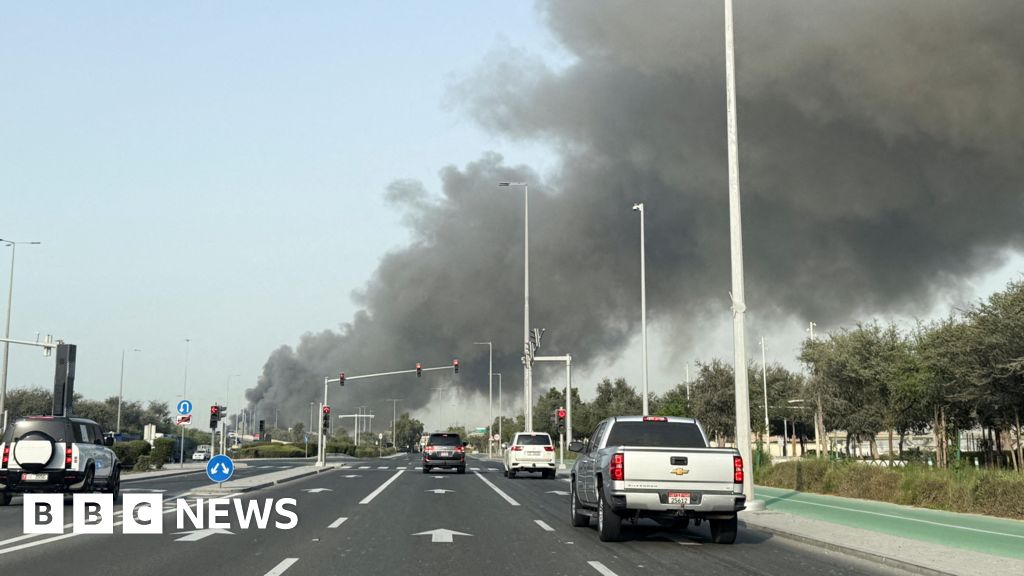
In a significant escalation of regional hostilities, United States allies in the Persian Gulf, particularly the United Arab Emirates (UAE) and Bahrain, are reportedly bearing the brunt of a sustained barrage of missile and drone attacks originating from Iran. The aerial assaults, which commenced on Saturday morning as part of what has been designated 'Operation Epic Fury,' have seen a notable shift in targeting, moving beyond traditional military installations to encompass civilian infrastructure. According to statements from the UAE defense ministry as of Sunday afternoon, their air defense systems have intercepted a staggering 165 ballistic missiles, two cruise missiles, and 541 Iranian drones. This unprecedented volume of incoming projectiles has transformed the typically tranquil skies above affluent cities like Abu Dhabi, where visible signs of aerial intercepts now punctuate the horizon, replacing the familiar sight of commercial airliners with the ominous trails of defensive maneuvers. The attacks underscore a rapidly deteriorating security situation across the Gulf, challenging the established peace in a region vital to global commerce and energy supplies.
The current wave of attacks represents a stark departure from the relative stability that has long characterized these Gulf nations, which were not designed with the anticipation of direct missile and drone threats to their urban centers. Historically, while regional tensions have simmered, direct and widespread assaults on civilian areas in the UAE and Bahrain have been uncommon. The conflict's initiation on Saturday morning marked a critical turning point, as Iranian forces appear to have broadened their operational scope. Initially, strikes seemed to focus on military assets, such as the crucial headquarters of the US Navy's 5th Fleet located in Bahrain. However, recent reports indicate a concerning expansion to non-military targets, including international airports, luxury accommodations, sprawling shopping complexes, and high-rise residential buildings. This evolution in targeting strategy suggests a deliberate intent to inflict broader disruption and potentially test the air defense capabilities of these allied nations, introducing an unprecedented level of insecurity to their populations and economies.
Detailed accounts from the affected areas paint a vivid picture of the escalating threat. Beyond the official figures released by the UAE defense ministry concerning the interception of hundreds of ballistic missiles, cruise missiles, and drones, personal testimonies highlight the immediate impact on residents. A witness in Bahrain, for instance, recounted a harrowing Sunday morning experience, describing a sleepless night punctuated by "huge bangs and wailing siren" and estimating "around 20 booms and bangs," with "at least two hits" impacting the airport vicinity. While some damage to civilian infrastructure is attributed to falling debris from intercepted projectiles, the sheer number of reported strikes on airports in both Bahrain and the UAE suggests a more direct and deliberate targeting strategy, rather than mere accidental collateral damage. These incidents expose potential vulnerabilities and gaps in the sophisticated air defense networks of these Gulf states, which were not originally conceived to withstand such a sustained and diverse array of aerial threats.
The motivations behind Iran's expanded targeting strategy remain a critical point of analysis. Iran's Foreign Minister, Abbas Aragchi, offered a specific clarification regarding his nation's actions during an interview with Al Jazeera. He explicitly denied that Iran was targeting its immediate neighbors in the Persian Gulf countries. Instead, Aragchi asserted, "We are not attacking our neighbours in the Persian Gulf countries, we are targeting the presence of the US in these countries. Neighbours should direct their grievances to the decision-makers of this war." This statement underscores Iran's consistent position that its actions are primarily aimed at challenging the American military presence in the region, effectively positioning the Gulf states as unwilling hosts in a broader geopolitical struggle. Experts suggest this rhetoric attempts to shift accountability for the attacks' consequences onto the US and its allies, while simultaneously increasing pressure on host nations to reconsider their alliances. The implications of this strategy are profound, risking further destabilization of the Gulf and potentially drawing more regional actors into the conflict, with significant economic and humanitarian ramifications.
The escalating Iranian missile and drone attacks on US allies in the Gulf mark a dangerous new phase in regional tensions, with civilian populations and critical infrastructure increasingly caught in the crossfire. The sheer volume of projectiles reported by the UAE defense ministry, coupled with eyewitness accounts of direct impacts on non-military sites, underscores a significant shift in the conflict's dynamics. While Iran's Foreign Minister maintains that the primary target is the American presence, the tangible impact is being felt acutely by its neighbors. This situation demands close international monitoring and diplomatic engagement to prevent further escalation. Observers will be watching for any shifts in Iran's targeting patterns, the effectiveness of Gulf states' air defenses, and the broader international response to what appears to be a deliberate strategy to challenge regional security paradigms and pressure US allies.