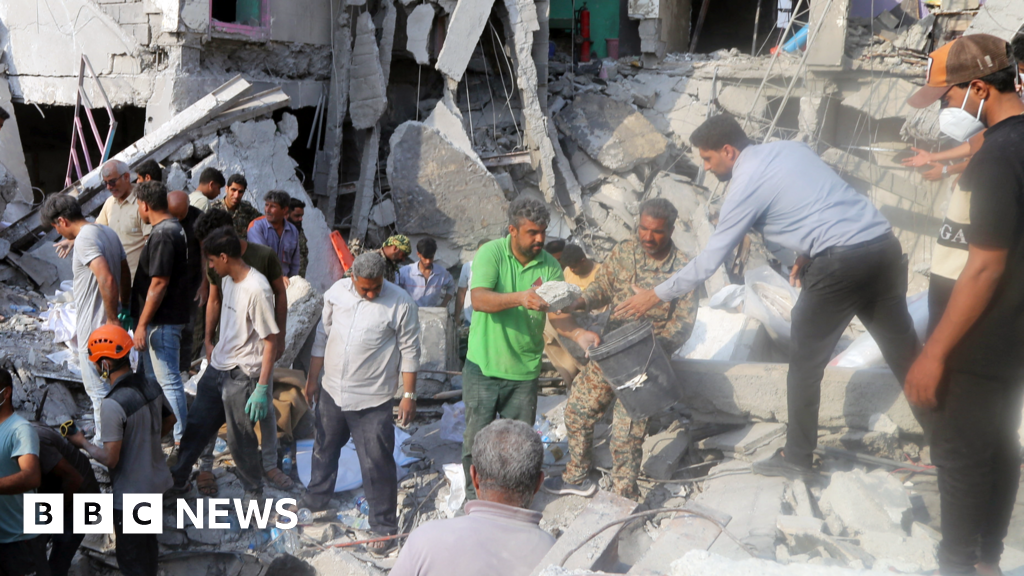
Iranian officials have reported a devastating explosion at a school in the southern part of the country, claiming the lives of at least 108 individuals. This tragic incident, according to a local prosecutor, occurred during what Tehran describes as extensive aerial assaults launched by the United States and Israel across the nation. President Masoud Pezeshkian vehemently condemned the event, characterizing it as a "barbaric act" and a "black page in the record of countless crimes committed by the aggressors." The school, located in the town of Minab within Hormozgan province, is situated approximately 600 meters (1,968 feet) from a base belonging to Iran's Revolutionary Guard Corps (IRGC), an entity that has reportedly been a primary target in the ongoing military operations. As of the latest reports, neither the United States nor Israel has issued any confirmation or comment regarding the alleged strike on the educational facility, leaving a critical information gap amidst escalating regional tensions.
The reported school attack unfolds against a backdrop of intensified military actions, with Iranian authorities asserting that the US and Israel have initiated a series of "massive air strikes" targeting various locations across the Islamic Republic. This broader campaign has reportedly resulted in significant casualties nationwide. The Iranian Red Crescent society has indicated that at least 201 people have been killed and 747 injured throughout the country as a direct consequence of these aerial bombardments. The proximity of the affected school in Minab to an IRGC base highlights a critical concern regarding civilian safety in conflict zones, especially when military installations are located near populated areas. The IRGC, a powerful branch of Iran's armed forces, plays a significant role in the country's defense and regional influence, making its facilities frequent targets in any broader military confrontation. International humanitarian organizations, including Red Cross and Red Crescent officials based in Geneva, have acknowledged the gravity of the situation, confirming that response teams have been mobilized to provide assistance at the site of the school incident.
Further details emerging from Iranian sources paint a grim picture of the incident in Minab. An unnamed official stated that the school was specifically "targeted by three missile attacks," leading to the high death toll reported by the local prosecutor. While independent verification remains challenging, the British Broadcasting Corporation (BBC) has reportedly verified video clips depicting the aftermath of the explosion. These clips show plumes of smoke ascending from a damaged building, with crowds gathering nearby and sounds of panic and screaming audible in the background. However, the BBC, like many international news organizations, has faced significant hurdles in independently confirming the exact number of fatalities due to severe restrictions on journalist visas to Iran, which considerably limits their capacity to gather on-the-ground information. The news of the devastating event has resonated deeply within Iran, with reports indicating widespread anger and condemnation expressed by users across various Iranian social media platforms, reflecting the profound public distress over the civilian casualties.
The alleged strike on a school, if independently confirmed, carries profound implications for regional stability and international relations, potentially marking a significant escalation in the ongoing tensions between Iran and the Western powers. The absence of confirmation from the United States and Israel regarding the attack on the school complex could be interpreted in several ways: it might suggest a denial of responsibility, an ongoing internal investigation, or a strategic silence aimed at managing the narrative. From an analytical perspective, the strong condemnation from Iranian President Pezeshkian, labeling the act as "barbaric," underscores Tehran's intent to frame the incident as a deliberate targeting of civilians, potentially galvanizing domestic support and international sympathy. Conversely, the proximity of the school to an IRGC base raises questions about targeting protocols and the inherent risks of collateral damage in military operations conducted near civilian infrastructure. Experts suggest that such incidents, regardless of intent, invariably fuel cycles of retribution and complicate diplomatic efforts towards de-escalation, further entrenching the adversarial positions of the involved parties.
In summary, Iranian authorities are reporting a catastrophic loss of life, with 108 individuals killed in an alleged US and Israeli missile strike on a school in southern Iran, amidst a broader campaign of aerial bombardments that has claimed over 200 lives nationwide. President Pezeshkian has denounced the attack as a "barbaric act," while the United States and Israel have yet to comment on the specific incident. The challenges faced by international media in independently verifying these claims underscore the opacity surrounding the conflict. As the situation develops, the international community will be closely watching for any further statements from the involved nations, potential independent investigations into the alleged school attack, and the broader implications for regional stability. The human cost of this escalating conflict remains a pressing concern, with calls for clarity and accountability likely to intensify.