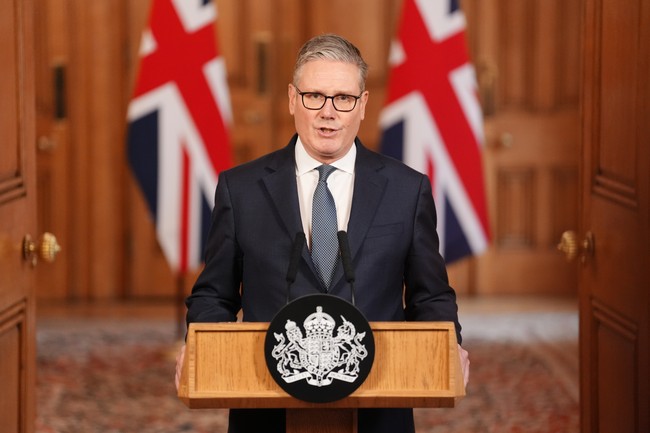
The United Kingdom has granted the United States permission to utilize British military installations for launching strikes against Iran, a significant and rapidly unfolding development reported by The Telegraph on March 1, 2026. This authorization signals a notable shift in the UK's stance regarding the volatile geopolitical landscape involving Iran, Israel, and the United States. Prime Minister Keir Starmer, who had previously maintained a position of non-commitment to direct involvement in the conflict, has reportedly reversed this decision. While the UK government has clarified that it will not be deploying its own military assets for direct combat operations against Iran, the allowance for American forces to operate from strategically important British bases provides the United States with enhanced logistical and operational capabilities in the region. This move comes amid escalating tensions, with various reports indicating that Iran's recent strategic decisions have been largely unsuccessful, inadvertently strengthening a growing international coalition aimed at countering the current regime's influence and actions across the Middle East. The decision underscores a deepening alignment between Western powers in addressing what many perceive as Iran's increasingly aggressive regional posture.
This pivotal decision by the UK unfolds against a backdrop of intensifying regional strife and a perceived failure of Iran's strategic objectives. According to various analyses, Iran's "endgame strategy" has been largely ineffective, characterized by a series of "terrible strategic decisions" that have exacerbated its international isolation rather than alleviating it. Reports suggest that the Iranian regime has been "flailing and striking out at everybody in the region," engaging in actions that have alienated numerous neighboring states and international actors. This aggressive posture, it is understood, was intended to pressure the United States into halting what Iran perceives as a "systematic dismantling of the regime." However, sources indicate that this approach has backfired significantly, inadvertently galvanizing a broader international "coalition" committed to countering Tehran's influence. The overarching "Iran-Israel-US conflict" encompasses a complex web of geopolitical rivalries, proxy wars, and nuclear proliferation concerns, with the United States and its allies consistently seeking to curb Iran's regional ambitions and support for non-state actors. The UK's decision to provide base access represents a tangible escalation in this ongoing effort to exert pressure on the Iranian leadership.
The reversal by Prime Minister Keir Starmer signifies a notable shift from a previously more cautious approach to the volatile Middle Eastern situation. While the precise details of the prior "decision to stay out" are not fully elaborated in reports, this new authorization clearly positions the UK as a logistical enabler for US military operations targeting Iran. It is crucial to note that, as specified in reports, this permission does not entail the deployment of British military personnel or aircraft into direct combat roles against Iran, but rather facilitates the use of UK sovereign territory for American strategic purposes. This distinction highlights a nuanced commitment, offering significant support without direct military engagement. The current situation is largely attributed to a profound "miscalculation" by Iran's leadership, both past and present, regarding the international community's response to its regional activities. Instead of deterring opposition, their actions have, according to sources, inadvertently accelerated the formation of a unified front. The ultimate aim of this burgeoning "coalition," as outlined in various analyses, is to "depose the current regime" in Tehran and foster the emergence of a "replacement one that is more friendly to its neighbors and the West," thereby promoting greater stability in a historically turbulent region.
The implications of the UK's decision are far-reaching, potentially reshaping the dynamics of the ongoing regional confrontation. Analysts suggest that providing the US with operational bases significantly enhances America's strategic flexibility and reach, sending a strong signal of unified Western resolve to Tehran. This move could be interpreted as a tangible step towards increasing pressure on the Iranian regime, moving beyond sanctions and diplomatic isolation to a more overt military posture. However, reports also caution about the inherent risks associated with such an aggressive strategy. The prospect of a "collapse of one regime without some military force to impose the rule of the next is a risky proposition," as noted in analyses, raising concerns about potential power vacuums, internal instability, or unintended consequences that could further destabilize the broader Middle East. Furthermore, the nature of any potential "replacement regime" remains highly uncertain. While the stated goal is a government "more friendly to its neighbors and the West," there are no guarantees that such an outcome would materialize smoothly or align perfectly with international expectations, underscoring the complex and unpredictable nature of regime change efforts.
In summary, the United Kingdom's decision to permit the United States to launch strikes against Iran from British bases marks a critical escalation in the long-standing tensions between Iran and Western powers. This policy reversal by Prime Minister Keir Starmer, while not committing UK combat forces, provides crucial logistical support to the US, signaling a strengthened international front against Tehran. The move is predicated on the assessment that Iran's current regional strategies have backfired, leading to increased isolation and the formation of a coalition seeking a more amenable leadership in Tehran. As the situation develops, observers will closely monitor the immediate operational impact of this decision, any potential responses from Iran, and the broader geopolitical ramifications for regional stability. The path forward remains fraught with complexities, particularly concerning the potential for regime change and the challenges of ensuring a stable transition.