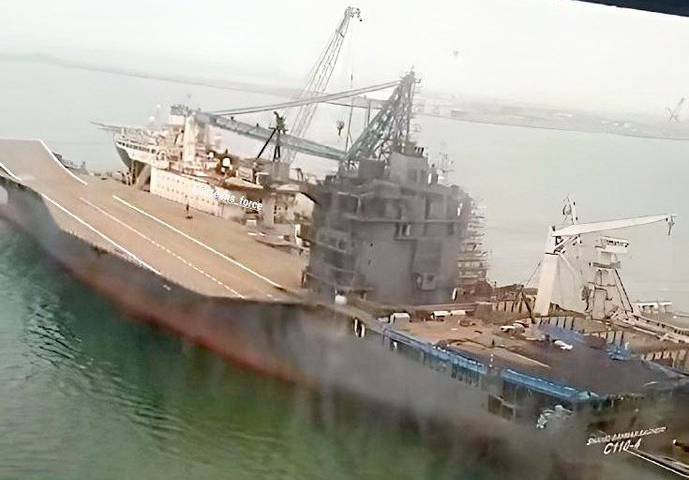
Recent reports indicate a significant discrepancy in naval engagement claims between Iran and the United States. Tehran's Islamic Revolutionary Guard Corps (IRGC) recently asserted that its forces successfully targeted the USS Abraham Lincoln, a prominent US Navy aircraft carrier, with four ballistic missiles. This claim, widely disseminated through local Iranian media, suggested the strike occurred during broader Iranian military operations against targets perceived to be linked to the United States and Israel. However, this assertion has been unequivocally rejected by the Pentagon and US Central Command (CENTCOM). Officials from CENTCOM, in a statement shared on social media, clarified that the USS Abraham Lincoln was not impacted and that any missiles launched did not approach the vessel. Furthermore, CENTCOM provided additional details, stating that the only aircraft carrier confirmed to have sustained a hit was, in fact, Iran's own Shahid Bagheri, a specialized drone carrier, which US forces reportedly struck within hours of initiating an operation designated "Epic Fury."
The Iranian claim regarding the USS Abraham Lincoln emerged amidst a period of heightened regional tensions, with the IRGC explicitly linking the alleged strike to recent military actions undertaken by Iran's armed forces against what it described as targets associated with American and Israeli interests. The statement, as reported by local media outlets, not only detailed the alleged impact of four ballistic missiles on the US Navy warship but also included a stark warning that "the land and sea will increasingly become the graveyard of the terrorist aggressors," according to the Guards. This aggressive rhetoric underscores Iran's declared intent to project military capability and deter perceived adversaries. In stark contrast to these claims, CENTCOM's subsequent clarification highlighted the reported targeting of Iran's Shahid Bagheri. This vessel, introduced by Iran last year, represents a significant development in its naval capabilities, being the nation's first dedicated drone carrier. Its unveiling marked an ambition to extend Iran's operational reach and enhance its asymmetric warfare strategies.
The IRIS Shahid Bagheri, the Iranian vessel confirmed by CENTCOM to have been struck, was unveiled by Tehran as a groundbreaking addition to its naval fleet. According to descriptions from Iranian state media, specifically IRNA, the Shahid Bagheri is characterized as an advanced maritime platform engineered for the launch and recovery of unmanned combat aircraft. These drones are reportedly capable of carrying out a range of missions, including both offensive strikes and reconnaissance operations. The vessel itself was reportedly converted from a commercial ship, a common practice for navies seeking to rapidly expand specialized capabilities. It is believed to feature a flight deck approximately 180 meters in length, designed to facilitate drone operations. Furthermore, its reported operational range extends an impressive 22,000 nautical miles, indicating its potential for sustained deployments in distant waters. Admiral Ali Reza Tangsiri, the chief of the Guard’s Navy, previously emphasized the strategic importance of this vessel, stating that its integration into the fleet marked "an important step in increasing the defense and deterrence capability of Iran in distant waters and in maintaining our national security interests." Beyond drones, the Shahid Bagheri was also designed to serve as a mobile base for helicopters, support fast-attack boats, and potentially deploy unmanned surface vessels (USVs) and short-range cruise missiles, underscoring its multi-role strategic utility.
CENTCOM's detailed rebuttal and counter-confirmation regarding the Shahid Bagheri carry significant implications for regional security dynamics and the ongoing information warfare between the United States and Iran. By explicitly refuting Iran's claims of hitting a US carrier and simultaneously confirming a strike on an Iranian asset, CENTCOM appears to be directly challenging Tehran's narrative and its "false messaging machine," as officials described it. This strategic communication aims to underscore the credibility of US military operations while discrediting Iranian propaganda. The reported disablement of the Shahid Bagheri, a vessel touted by Iranian officials like Admiral Tangsiri as crucial for projecting power and enhancing deterrence in "distant waters," represents a tangible setback for Iran's naval ambitions. While Iran seeks to demonstrate its capacity to threaten major US naval assets, the US response highlights its ability to neutralize key Iranian strategic platforms. This incident could be interpreted as a clear message regarding the consequences of escalating rhetoric and actions, potentially influencing future calculations in the volatile Middle East. The contrast between Iran's aspirational claims and the verifiable US military action against a high-value Iranian asset underscores the disparity in operational capabilities and the challenges Iran faces in asserting dominance against a technologically superior adversary.
In conclusion, the recent exchange of claims and counter-claims between Iran and the United States highlights a critical juncture in their ongoing military and informational rivalry. While Iran's Islamic Revolutionary Guard Corps asserted a significant strike against the USS Abraham Lincoln, a claim swiftly and definitively denied by the Pentagon and US Central Command, the US military has, in turn, confirmed its own successful operation. CENTCOM's revelation that US forces targeted and hit Iran's Shahid Bagheri drone carrier during "Operation Epic Fury" shifts the narrative dramatically, transforming an alleged Iranian triumph into a confirmed setback for Tehran's naval capabilities. This incident not only exposes the differing realities presented by both sides but also underscores the operational readiness of US forces in the region. Moving forward, observers will be closely watching for any further statements from either nation, as well as the broader implications for maritime security and the delicate balance of power in the Middle East, particularly concerning Iran's strategic assets and its future naval posture.