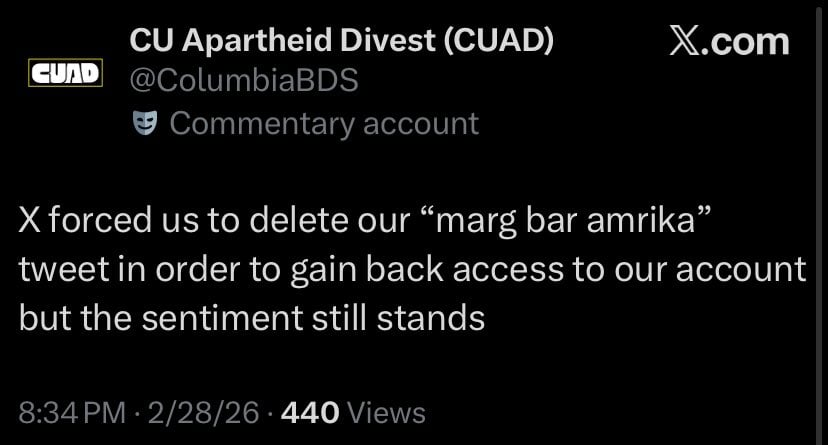
A student coalition at Columbia University, known as Columbia University Apartheid Divestment (CUAD), which includes the Students for Justice in Palestine (SJP) among its members, recently sparked significant controversy by posting the phrase 'Marg bar Amirka' on its Twitter account. This phrase, widely recognized as Iran's long-standing slogan translating to 'Death to America,' was reportedly shared in the aftermath of a U.S. military action, authorized by then-President Trump, targeting what officials described as Islamic terrorist elements in Iran. Although the tweet was subsequently removed from the platform, the group reportedly affirmed that the underlying sentiment behind the message remained unchanged, declaring that 'the sentiment still stands.' This incident has ignited a heated debate regarding the boundaries of student activism, free speech on university campuses, and the perceived alignment of certain student organizations with foreign adversaries, drawing sharp criticism from various observers and prompting calls for accountability, according to recent reports.
The phrase 'Marg bar Amirka' has a deep historical context, serving as a potent anti-American rallying cry in Iran since the 1979 Islamic Revolution. Its deployment by a prominent student group at an esteemed American institution like Columbia University immediately drew parallels to geopolitical tensions and raised questions about the ideological leanings of some campus organizations. Reports indicate that CUAD, a coalition advocating for divestment from companies linked to Israel, has a history of controversial stances, but this particular incident escalated concerns due to its direct invocation of a hostile slogan against the United States. The timing of the tweet, following a specific U.S. military operation, further contextualizes the group's perceived intent and has led to intensified scrutiny of its activities and affiliations, particularly those of its SJP component, which has been described by some sources as an auxiliary to groups with extremist ties.
Adding another layer of complexity to the controversy, reports highlight the reported involvement of Mahmoud Khalil, identified as a prominent figure within CUAD. Khalil, described as an 'enemy national' facing deportation proceedings, had previously garnered support from various Democratic circles, making his alleged role in the student group's activities a point of particular contention. Concurrently, a separate but related incident involved the Students for Justice in Palestine chapter at the University of Chicago. This chapter reportedly shared propaganda videos depicting attacks by the Iranian regime against American military personnel, further fueling concerns among critics about the nature of SJP's activism and its potential to disseminate hostile foreign narratives on U.S. campuses. These combined incidents have intensified calls for universities to address the content and implications of such student-led communications, with specific data points like the 'enemy national' status of a key figure underscoring the gravity of the situation.
The incidents at both Columbia University and the University of Chicago have ignited a broader discussion about the role of student organizations in national security matters and the responsibilities of academic institutions. A critical perspective, articulated by sources close to the original report, characterizes Students for Justice in Palestine as an 'auxiliary for Islamic terrorist groups,' asserting that the group is no longer concealing this alleged affiliation. This viewpoint further suggests that individuals associated with such groups should face deportation, raising significant legal and ethical questions about freedom of speech versus national security concerns on campus. The source also draws a stark contrast with past campus debates, recalling an instance at the University of Chicago Law School where students were reportedly deemed to make others feel 'unsafe' for merely sitting together, questioning the disparity in institutional responses when confronted with expressions that seemingly celebrate attacks on American forces. This analysis underscores a growing sentiment among some observers that certain forms of student activism cross a line from protected speech into potentially dangerous advocacy.
In conclusion, the 'Marg bar Amirka' tweet by Columbia University's CUAD, its subsequent deletion, and the group's steadfast affirmation of the sentiment, coupled with the University of Chicago SJP's sharing of anti-American propaganda, represent a significant flashpoint in the ongoing debate over student activism and campus climate. The reported involvement of a figure like Mahmoud Khalil, an 'enemy national' facing deportation, further complicates the narrative, intertwining campus politics with national security concerns. As these events unfold, they continue to prompt critical questions about the boundaries of free expression, the responsibilities of university administrations, and the potential implications for student safety and national interests. Observers will be closely watching for any official responses from the universities involved and for further developments regarding the legal and political ramifications of these controversial student actions.