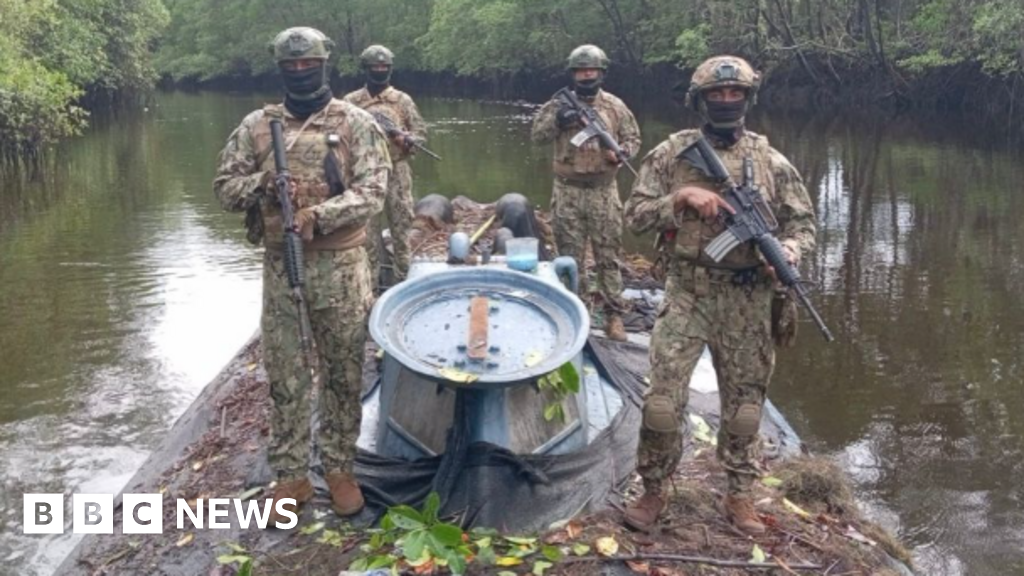
Ecuadorean military personnel recently uncovered a substantial 35-meter (115-foot) semi-submersible vessel, commonly referred to as a 'narco-submarine,' concealed within a nature reserve situated near the nation's border with Colombia. This significant discovery, announced by Ecuador's Ministry of Defence, revealed the vessel was fully provisioned with approximately 22,700 liters (6,000 gallons) of fuel, indicating its readiness for an extended illicit journey for drug smuggling. The operation unfolded shortly after President Daniel Noboa declared a heightened 'new phase' in his administration's intensified campaign against powerful drug cartels operating within the country. The find underscores the escalating sophistication of criminal organizations and the persistent challenges faced by authorities in a region increasingly pivotal to the global narcotics trade, as officials continue their efforts to disrupt these complex networks.
Ecuador's geographical position has rendered it an increasingly critical transit hub for the international drug trade. Sandwiched between Colombia and Peru, which are recognized as the world's leading producers of cocaine, the nation serves as a strategic corridor for illicit narcotics destined for markets in the United States, Europe, and even as far as Australia. The presence of such advanced smuggling apparatuses, like the recently seized semi-submersible, highlights the adaptive strategies employed by criminal syndicates to circumvent interdiction efforts. Historically, drug traffickers have evolved from using conventional boats to employing more clandestine methods, including sophisticated vessels designed to travel largely submerged, making them exceptionally difficult to detect by radar or visual surveillance, thereby complicating regional security efforts significantly.
The discovery operation took place specifically within a mangrove swamp located in the Cayapas–Mataje nature reserve, a challenging terrain that offers natural concealment for illicit activities. Beyond the impressive 35-meter semi-submersible, security forces also unearthed a nearby encampment, which officials indicated was being utilized by criminal elements as a logistical base to prepare vessels for their clandestine voyages. Further seizures included six speedboats, seven powerful outboard motors, and numerous barrels of fuel, all indicative of a well-resourced and organized smuggling operation. During the course of the intervention, military personnel reportedly came under fire from 'armed individuals,' according to statements from the defence ministry, highlighting the dangerous nature of these anti-narcotics missions. However, official reports did not mention any arrests made in connection with the find, nor was there any indication of drugs being seized directly from the submarine or the camp at the time of the announcement.
This significant seizure reflects the ongoing, high-stakes battle between Ecuadorean authorities and powerful transnational criminal organizations. The sheer size and fuel capacity of the semi-submersible suggest a substantial investment by drug cartels, indicating their deep financial resources and advanced engineering capabilities dedicated to maintaining their illicit supply chains. The incident also provides tangible evidence of President Noboa's commitment to his declared 'new phase' against organized crime, signaling a more aggressive stance from the government. Furthermore, reports indicate President Noboa has been actively collaborating with the Trump administration on initiatives aimed at curbing the flow of narcotics from Ecuador into the United States, underscoring the international dimension of this challenge. The use of such sophisticated vessels poses a formidable challenge to maritime security, requiring advanced surveillance and interdiction technologies to effectively counter these elusive threats across vast oceanic routes.
The discovery of this large narco-submarine in a protected nature reserve serves as a stark reminder of the persistent and evolving threat posed by drug trafficking in Ecuador and across South America. It underscores the continuous cat-and-mouse game between law enforcement agencies and highly adaptable criminal syndicates. As President Noboa's administration intensifies its efforts, supported by international cooperation, the focus will remain on dismantling these complex networks and intercepting their increasingly sophisticated tools. The absence of reported arrests or drug seizures in this specific operation highlights the challenges of fully disrupting these operations, suggesting that while the vessel was neutralized, the individuals behind it may still be at large, prompting continued vigilance and strategic interventions in the fight against organized crime.