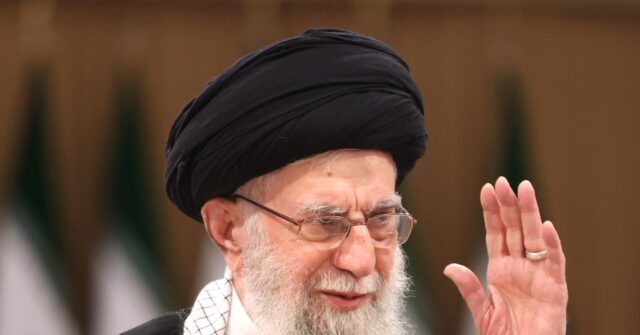
Iranian Supreme Leader Ayatollah Ali Khamenei has reportedly been killed in a targeted operation, according to initial reports from Fox News. The prominent news outlet indicated that Khamenei's demise occurred during an Israeli air strike on his compound located in Tehran on Saturday. This significant event was described as a joint military endeavor involving both Israeli and United States forces. Subsequent to these initial reports, U.S. President Donald Trump publicly confirmed the death of the Iranian Supreme Leader. Utilizing his Truth Social platform, President Trump declared Khamenei "is dead," marking a pivotal moment in the ongoing geopolitical landscape of the Middle East. The confirmation from the highest levels of the U.S. government lends considerable weight to the reports, signaling a major development with potentially far-reaching consequences for regional stability and international relations. The operation, reportedly codenamed 'Operation Epic Fury', represents a dramatic escalation in the long-standing tensions between Iran and its adversaries.
Ayatollah Ali Khamenei, who was 86 years old at the time of his reported death, had been the paramount religious and political authority in the Islamic Republic of Iran since 1989. His ascension to the role of Supreme Leader followed a tenure as president of Iran, a position he held from 1981. For over three decades, Khamenei wielded ultimate power, overseeing all major state policies, military decisions, and judicial appointments, shaping Iran's domestic and foreign policy significantly. His leadership has been characterized by staunch opposition to Western influence, particularly from the United States and Israel, and a commitment to the principles of the Islamic Revolution. The reported strike on his Tehran compound, a central symbol of Iranian power, underscores the volatile nature of the region and the deep-seated animosity between the involved parties. This event marks the end of an era for Iran, potentially ushering in a period of profound uncertainty regarding the country's future leadership and strategic direction.
In his statement confirming Khamenei's death, President Trump did not mince words, describing the late Supreme Leader as "one of the most evil people in History." The U.S. President framed the operation as an act of justice, not only for the Iranian populace but also for "all Great Americans" and individuals from numerous countries globally who, according to Trump, had suffered deaths or mutilations at the hands of Khamenei and what he termed his "gang of bloodthirsty THUGS." President Trump further asserted the sophisticated capabilities of the joint forces, stating that Khamenei was "unable to avoid our Intelligence and Highly Sophisticated Tracking Systems." He also indicated that Khamenei was not the sole casualty, noting that "other leaders that have been killed along with him" were also unable to evade the operation. This suggests a broader, coordinated strike targeting multiple high-value individuals within the Iranian leadership structure, amplifying the impact of the reported assassination.
President Trump's address extended beyond merely confirming Khamenei's death, issuing a direct appeal to the Iranian people to "rise up and take back their country." He also specifically urged Iranian police, military, and security services to surrender immediately, offering them immunity from prosecution if they comply. Trump ominously warned, referencing a previous statement, that while "Now they can have Immunity, later they only get Death!" This stark ultimatum highlights a clear intention to facilitate a significant internal shift within Iran. The U.S. President expressed hope that the Islamic Revolutionary Guard Corps (IRGC) and the police would "peacefully merge with the Iranian Patriots" to restore the country to its "Greatness." Furthermore, Trump claimed that not only Khamenei's death but also the country itself had been "very much destroyed and, even, obliterated" in a single day. He concluded by stating that "heavy and pinpoint bombing" would persist "uninterrupted throughout the week or, as long as necessary" to achieve the ultimate objective of "PEACE THROUGHOUT THE MIDDLE EAST AND, INDEED, THE WORLD!" These statements suggest a comprehensive strategy aimed at regime change and regional reordering.
The reported assassination of Ayatollah Ali Khamenei, confirmed by U.S. President Donald Trump, represents a seismic event with immediate and profound implications for Iran and the broader Middle East. The joint U.S.-Israeli operation, described as 'Operation Epic Fury', signifies a dramatic escalation in the long-standing geopolitical tensions. President Trump's strong rhetoric, labeling Khamenei as historically evil and calling for an immediate uprising and surrender from Iranian security forces, clearly outlines an objective beyond mere targeted killing. The stated continuation of "heavy and pinpoint bombing" until regional and global peace is achieved indicates an ongoing military campaign. The world will now be watching closely for the immediate reactions within Iran, including potential succession plans, and the broader international responses to this unprecedented development, as the region braces for what could be a period of significant instability and transformation.