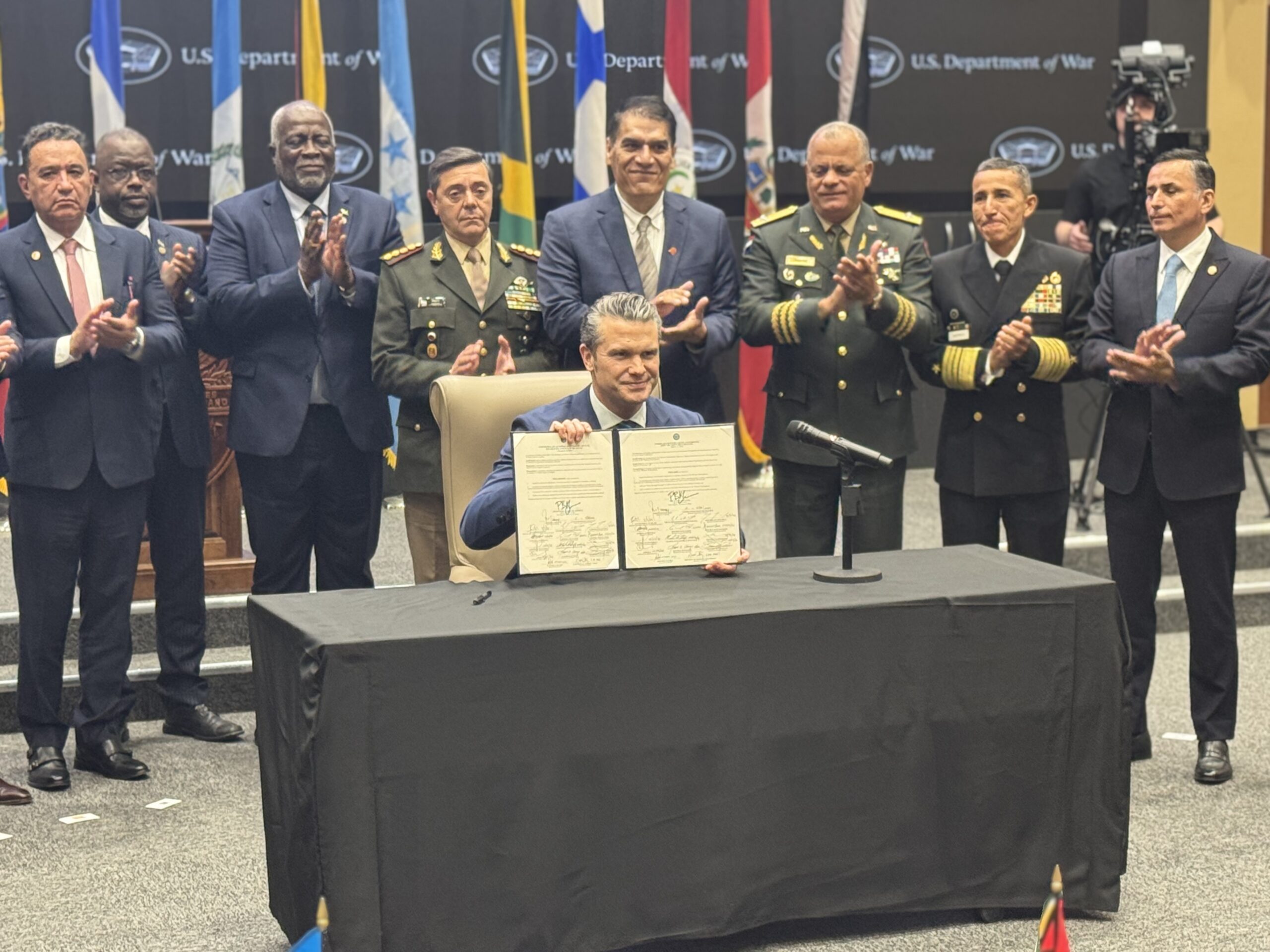
U.S. Secretary of War Pete Hegseth recently formalized a significant security pact, bringing together the United States with seventeen other nations across the Western Hemisphere. This collaborative initiative, signed on Thursday, aims to forge a united front against narcoterrorist organizations operating within the region, primarily through the application of military deterrence. The declaration was signed during a high-level assembly of defense and security officials representing countries from South America, Central America, and the Caribbean. The pivotal event took place at the U.S. Southern Command (SOUTHCOM) headquarters located in Doral, Florida, marking a concerted effort to enhance regional stability and counter transnational criminal threats. According to reports from the meeting, this multilateral agreement signifies a renewed commitment to collective security, designed to disrupt the operational capabilities and financial networks of groups that exploit vulnerable populations and destabilize governance throughout the Americas. Officials present at the signing emphasized the necessity of a unified military posture to effectively deter and dismantle these dangerous networks, which pose a direct challenge to the sovereignty and well-being of all participating nations.
The gathering at SOUTHCOM headquarters brought together a diverse group of security and defense leaders, reflecting the widespread concern over the escalating influence of narcoterrorist groups. These organizations, often intertwined with drug trafficking, human smuggling, and other illicit activities, have long presented a formidable challenge to governance and public safety across the Western Hemisphere. The U.S. Southern Command, headquartered in Florida, serves as the primary U.S. security cooperation organization in the region, responsible for contingency operations and security cooperation in Central and South America and the Caribbean. Its role in facilitating such a high-level declaration underscores the strategic importance of this region to U.S. national security. Historically, the United States has engaged in various bilateral and multilateral efforts to combat drug trafficking and associated criminal enterprises in the Americas. This new declaration, however, signals a more formalized and militarily focused approach, aiming to consolidate regional efforts under a shared strategic framework to address threats that transcend individual national borders. The persistent nature of these threats, impacting economic stability, social cohesion, and democratic institutions, necessitates such a comprehensive and coordinated response, according to regional security analysts.
The meeting featured significant contributions from several key U.S. officials, alongside remarks from each participating delegation head. Among the prominent speakers were Secretary Hegseth himself, White House Deputy Chief of Staff and Homeland Security Advisor Stephen Miller, SOUTHCOM Commander General Francis Donovan, and Joseph Humire, who serves as the acting Assistant Secretary of War for Homeland Defense and Americas Security Affairs. During his address, Secretary Hegseth articulated a stark assessment of the threats facing the region. He emphasized that when "terrorist killers and cartels" gain control over critical infrastructure, natural resources, or even entire towns and cities in proximity to U.S. borders and coastlines, or when they profit substantially from extensive illegal migration, these actions directly imperil the security of the United States homeland. Furthermore, Hegseth stressed that these same threats extend equally to all nations within the Americas, highlighting a shared vulnerability that necessitates collective action. His comments underscored the multifaceted nature of the challenge, linking traditional narcoterrorism with broader issues of border security and regional stability, as reported by attendees.
Secretary Hegseth's remarks extended beyond the immediate threat of narcoterrorism, framing the challenge within a broader geopolitical context. He asserted that the adversaries threatening the region's "shared heritage" also jeopardize its "shared geography." According to Hegseth, these groups are actively working to displace the traditional North-South relationship that has historically characterized alliances within the Americas. Instead, they seek to foster a new paradigm, which he termed a "Global South," designed to exclude the United States and other Western nations. This proposed "Global South," as described by Hegseth, would instead incorporate non-Western powers and other geopolitical adversaries, thereby reshaping regional dynamics to the detriment of established alliances. This perspective suggests that the fight against narcoterrorism is not merely a law enforcement or military operation but also a strategic battle for influence and alignment within the Western Hemisphere. Experts suggest that such a declaration, backed by military deterrence, aims to reinforce traditional partnerships and counter perceived attempts by external actors to undermine U.S. and Western influence in a strategically vital region. The Secretary's analysis positions the current security declaration as a bulwark against both immediate criminal threats and long-term geopolitical realignments.
The joint security declaration signed by Secretary Hegseth and 17 Western Hemisphere nations represents a significant escalation in the coordinated effort to combat narcoterrorism. By establishing a unified front and committing to military deterrence, the participating countries aim to dismantle criminal networks that threaten regional stability, exploit vulnerable populations, and undermine sovereign governance. The initiative, spearheaded from the U.S. Southern Command, underscores the critical importance of multilateral cooperation in addressing transnational threats that transcend individual national capacities. As the declaration moves towards implementation, observers will be closely watching for the practical application of military deterrence and the effectiveness of enhanced intelligence sharing and coordinated operations. The broader geopolitical implications, as articulated by Secretary Hegseth, suggest that this partnership is also a strategic move to reaffirm traditional alliances and counter emerging influences that seek to redefine the Western Hemisphere's international relationships. The success of this unified approach will be crucial in shaping the future security landscape of the Americas.