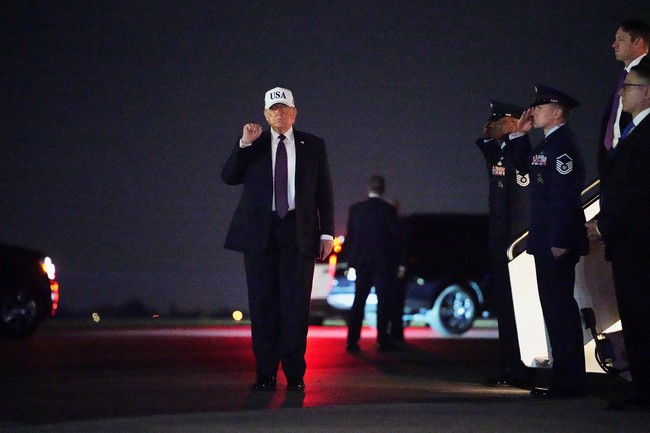
A significant shift in presidential rhetoric regarding Iran has fueled speculation about potential military engagement, with observers noting a marked departure from previous diplomatic overtures. Throughout a recent Friday, President Donald Trump's public statements, beginning with remarks on the White House lawn and continuing at a rally in Texas, adopted a more confrontational tone. This change in language, moving from an emphasis on negotiation to the potential necessity of military force, has been widely interpreted as a precursor to imminent kinetic action, according to reports. This anticipated escalation draws historical parallels to major military operations, such as the initial phase of the Iraq War in March 2003, famously dubbed 'Shock and Awe.' That campaign, launched by then-Secretary of Defense Donald Rumsfeld and President George W. Bush, promised an overwhelming display of force, a promise that was indeed fulfilled with a wave of approximately 300 strikes, though their scale was reportedly dwarfed by a more recent, unspecified military operation.
The 'Shock and Awe' campaign, which commenced on March 19, 2003, marked the beginning of the Iraqi phase of the Global War on Terror. Officials at the time, including Secretary Rumsfeld and President Bush, had publicly stated that the operation would be characterized by its sheer intensity and impact. This initial wave of aerial bombardment targeted key installations of Saddam Hussein's Baathist regime across Iraq. While the precise number of strikes remains classified, reports indicate it was around 300, covering a substantial geographical area. Despite the overwhelming nature of these initial assaults, designed to paralyze the regime, Saddam Hussein himself, along with many of his most trusted loyalists, managed to survive the immediate impact. The subsequent effort to apprehend the Iraqi leader proved to be a protracted endeavor, ultimately taking nine months before he was finally captured from a hiding place, highlighting the complexities and unforeseen challenges even in large-scale military interventions.
More recently, President Trump's public discourse concerning Iran underwent a noticeable transformation over the course of a single day. Previously, the President had often articulated a belief that Iranian leadership desired a deal, leaving the specifics open to interpretation. However, on a recent Friday, his messaging shifted dramatically. During an impromptu press interaction on the White House lawn, and subsequently in more extensive remarks delivered at a rally in Texas, President Trump began to articulate a different perspective. His statements moved away from the prospect of a diplomatic resolution, instead introducing the idea that while it would be preferable to avoid military intervention, such action might, at times, become a necessary course. This distinct change in rhetorical emphasis, according to various analyses, signaled a clear and imminent potential for military engagement, indicating a departure from a purely negotiation-focused approach.
The implications of such a pronounced shift in presidential rhetoric are significant, suggesting a potential re-evaluation of diplomatic strategies in favor of a more assertive stance. The historical precedent of 'Shock and Awe' serves as a reminder that even massive, coordinated military actions do not always yield immediate or complete desired outcomes, as evidenced by Saddam Hussein's survival of the initial 2003 strikes and the subsequent nine-month hunt for him. Experts suggest that a move towards kinetic action, as implied by the recent statements, carries substantial risks and requires careful consideration of potential long-term consequences, both regionally and globally. The transition from expressing a desire for a deal to acknowledging the potential necessity of military force indicates a heightened state of tension and a readiness to consider non-diplomatic solutions, which could reshape the geopolitical landscape in the Middle East, according to various foreign policy analysts.
In summary, the recent pivot in President Trump's public statements regarding Iran has created an expectation of potential military action, drawing comparisons to the historical 'Shock and Awe' campaign of 2003. While the 2003 operation was a significant display of force, its initial outcomes demonstrated the inherent challenges in achieving immediate objectives through military means, as Saddam Hussein evaded capture for an extended period. The current rhetorical shift signals a departure from a purely diplomatic approach, indicating a readiness for kinetic engagement. As the situation develops, observers will closely monitor further statements and actions from the administration, assessing the potential for military intervention and its broader implications for regional stability and international relations. The historical context underscores the complexities inherent in such high-stakes decisions.