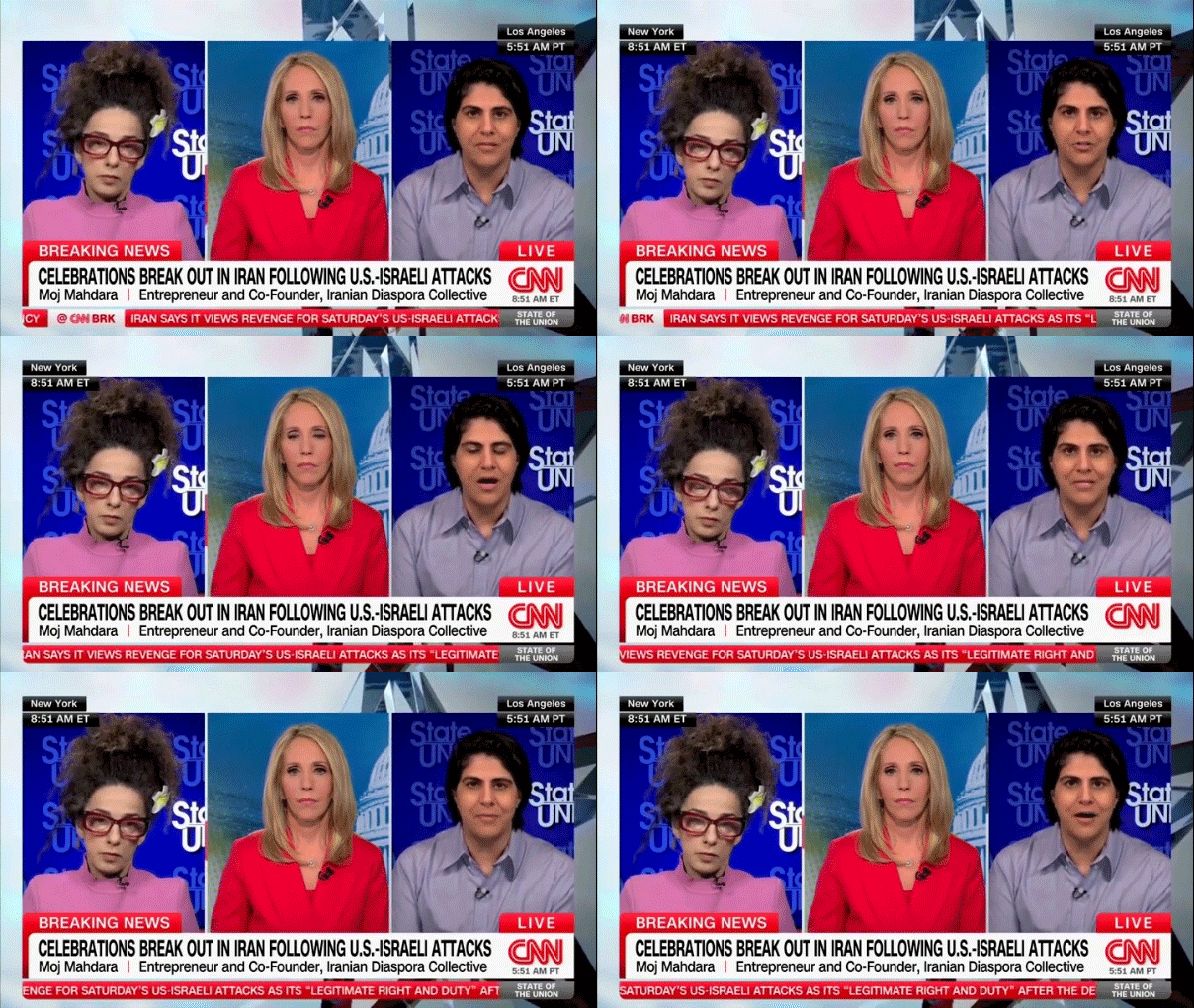
Prominent Iranian-American advocate Moj Mahdara recently voiced profound disappointment regarding the Democratic Party's reaction to the significant joint military actions undertaken by the United States and Israel against Iran. Speaking on Sunday, Mahdara, who is a co-founder of the Iranian Diaspora Collective, urged her party to reassess its priorities, asserting that the situation transcends internal political disagreements or existing international conflicts. She emphasized that the ongoing developments, particularly the reported consequences of the operation, represent a critical juncture for national security and the future stability of the Middle East. Her comments came in the wake of a substantial military offensive, dubbed 'Operation Epic Fury,' which reports indicate has resulted in the deaths of several key Iranian figures, including the nation's Supreme Leader, Ayatollah Ali Khamenei. Mahdara's critique underscores a growing divergence of opinion within the Democratic ranks concerning foreign policy in the volatile region, highlighting a perceived disconnect between the party's official stance and what she views as a historic opportunity for global change.
The backdrop to Mahdara's strong statements is 'Operation Epic Fury,' a massive joint military endeavor reportedly launched by the U.S. and Israel on Saturday. This operation, according to various reports, targeted significant elements within Iran and has had profound implications, including the reported demise of major leaders, most notably Iranian Supreme Leader Ayatollah Ali Khamenei. Mahdara, a self-identified Democrat, expressed her conviction that these actions are not merely isolated incidents but rather a pivotal moment with far-reaching consequences. As a co-founder of the Iranian Diaspora Collective, her perspective is informed by a deep understanding of the region and the Iranian regime's historical impact. She conveyed her sentiments during an interview on CNN's 'State of the Union' with host Dana Bash, where she articulated a clear call for her party to 'wake up' and recognize the gravity and potential of the unfolding events, suggesting that the current response from many Democrats falls short of the moment's significance.
Mahdara's critique specifically targeted what she perceives as the Democratic Party's misplaced focus, arguing that many members are allowing their antipathy towards former President Donald Trump to overshadow critical national security considerations. She asserted that it is 'imperative' for the party to move beyond such sentiments and acknowledge the broader implications of the recent military actions. According to Mahdara, the situation is fundamentally about national security and the potential for a transformative shift in the Middle East. She highlighted the importance of fostering strong partnerships with Gulf States, aligning with their aspirations for regional stability. Mahdara drew a powerful historical parallel, suggesting that the reported 'dismemberment and decapitation' of the Iranian regime could usher in changes comparable to the fall of the Soviet Union and the tearing down of the Berlin Wall, signifying an unparalleled opportunity for global realignment and progress.
The advocate further elaborated on the extensive ripple effects she anticipates from such a significant shift in Iran's leadership. Mahdara posited that dismantling the current Iranian regime could trigger substantial changes not only across the Middle East but also in distant regions such as Venezuela, China, and Ukraine. She firmly believes that the ideology propagated by the Iranian regime has historically generated considerable challenges on a global scale, and therefore, its reported weakening presents a 'tremendous opportunity' that must be taken seriously. Her analysis suggests that the impact of these events extends far beyond immediate geopolitical concerns, potentially reshaping international dynamics and power structures. This perspective underscores a profound disagreement with the prevailing sentiment she observes within her own party, leading her to state that, at present, she struggles to 'see herself in the Democratic Party' given their current response to these critical developments.
In conclusion, Moj Mahdara's impassioned plea serves as a significant voice within the Iranian-American community and the Democratic Party, urging a re-evaluation of foreign policy priorities in light of the recent US-Israel military operations against Iran. Her 'incredible disappointment' stems from a conviction that the reported actions, including the death of Ayatollah Ali Khamenei, present a historic and unparalleled opportunity for national security and global transformation. Mahdara's call for Democrats to transcend internal political divisions and recognize the profound implications of these events highlights a potential fault line within the party's approach to international affairs. As the situation in the Middle East continues to evolve, observers will be closely watching how the Democratic Party responds to such internal criticisms and whether Mahdara's vision of a new regional and global order gains broader traction within its ranks.