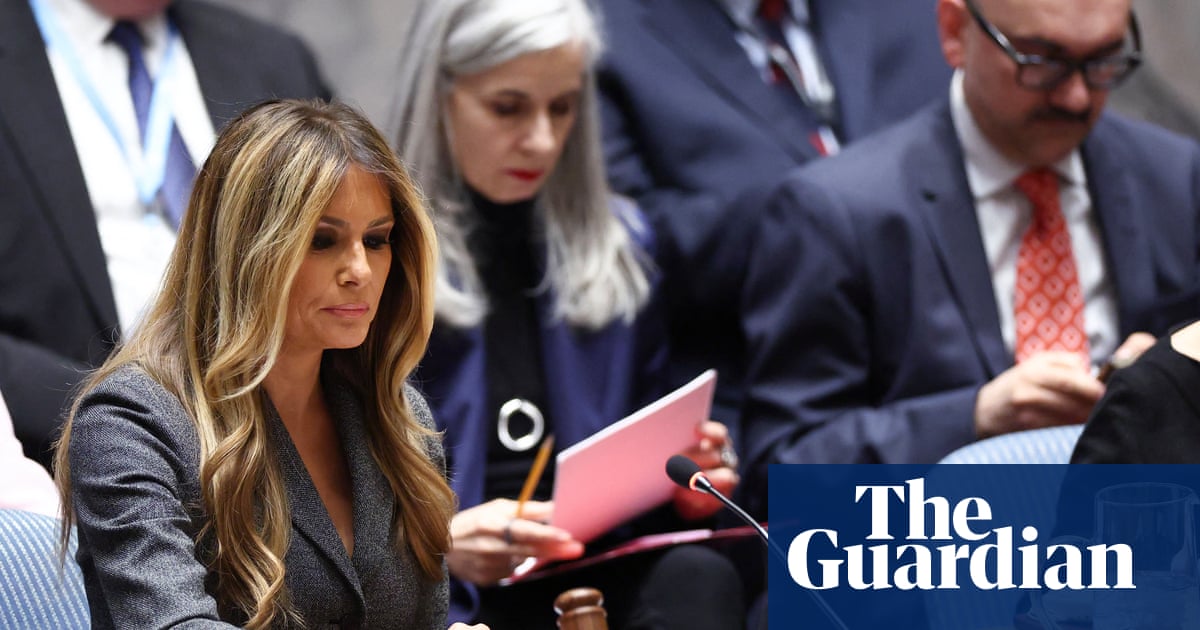
Melania Trump, the spouse of a sitting world leader, made a notable appearance at the United Nations Security Council on Monday, marking a historic occasion as she became the first individual in her role to preside over the esteemed international body. Her address focused on the critical importance of safeguarding children's access to education, particularly in regions afflicted by conflict. This significant call to action came mere days after distressing reports emerged from Iranian state media, detailing a devastating airstrike that reportedly claimed the lives of at least 165 individuals and left 96 others injured at a girls' school situated in southern Iran. The timing of her speech underscored the urgent global challenges facing vulnerable populations, with her remarks resonating against a backdrop of recent geopolitical tensions and humanitarian concerns. The meeting, specifically titled 'Children, Technology and Education in Conflict,' had been pre-scheduled, indicating a long-standing commitment to these issues, even as new crises unfolded.
The decision for a First Lady to preside over a session of the UN Security Council represents an unprecedented moment in diplomatic history, elevating the discourse on humanitarian issues to the highest echelons of international security deliberations. Typically, the Security Council's proceedings are led by representatives of member states, making Mrs. Trump's presence a unique departure from established protocol and a testament to the growing recognition of the role non-state actors, including spouses of heads of state, can play in global advocacy. Her emphasis on protecting educational opportunities for children in war-torn areas aligns with broader United Nations objectives to mitigate the long-term impact of conflict on future generations. The reported incident in Iran, where an educational institution suffered such severe casualties, starkly illustrates the profound and tragic consequences when these protections fail, highlighting the urgency of the First Lady's appeal to member states to reinforce their commitments to these fundamental rights.
Reports from Iranian state media painted a grim picture of the aftermath of the airstrike in southern Iran, indicating a catastrophic loss of life and widespread injuries. The incident, which reportedly targeted a girls' school, resulted in the deaths of 165 people and left an additional 96 wounded, according to the accounts. Such an attack on an educational facility, particularly one serving young girls, underscores the severe vulnerability of civilian infrastructure and non-combatants in conflict zones. The specific details of the casualties and the nature of the target amplify the humanitarian crisis and the urgent need for international attention to the protection of educational environments. While the Security Council meeting's agenda, 'Children, Technology and Education in Conflict,' was established prior to these events, the timing of the First Lady's address immediately following such a tragedy added a poignant and immediate relevance to her message. Furthermore, the broader geopolitical landscape was marked by other significant military actions, with reports indicating that the United States and Israel had launched their own strikes against Iran on the preceding Saturday, further complicating the regional security situation.
The confluence of Melania Trump's historic address and the reported tragedy in Iran brings into sharp focus the complex interplay between global diplomacy, humanitarian concerns, and ongoing geopolitical conflicts. Her call for the protection of children's education, delivered from such a prominent platform, serves as a powerful reminder of the international community's responsibility to shield the most vulnerable from the ravages of war. The reported strike on the Iranian school, irrespective of its perpetrator, underscores the devastating reality that educational institutions, which should be sanctuaries, often become targets or collateral damage in armed conflicts. This situation highlights the persistent challenge of upholding international humanitarian law and ensuring the safety of civilians, particularly children, in volatile regions. The inclusion of 'Technology' in the meeting's title also suggests a forward-looking perspective, acknowledging both the potential for technology to aid education in crisis and the risks it poses in modern warfare, further complicating efforts to protect learning environments.
In summary, Melania Trump's unprecedented role in presiding over a UN Security Council meeting to advocate for children's education marks a significant moment in international diplomacy, drawing global attention to a critical humanitarian issue. Her impassioned plea for the protection of educational access came at a particularly poignant time, just days after Iranian media reported a devastating airstrike on a girls' school, resulting in numerous casualties. This convergence of events underscores the urgent need for robust international mechanisms to safeguard children and educational facilities in conflict zones. As the global community continues to grapple with complex geopolitical tensions and humanitarian crises, the focus on education remains paramount for fostering stability and future prosperity. Observers will be watching to see how this high-profile intervention translates into concrete actions and renewed commitments from member states to protect the fundamental right to education for all children, especially those caught in the crossfire of conflict.