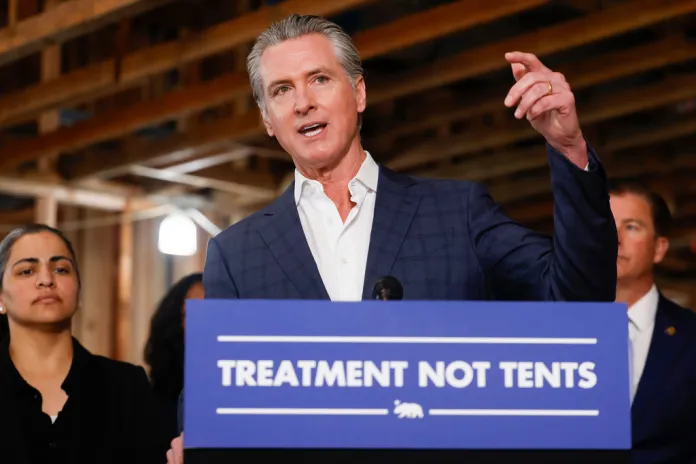
California Governor Gavin Newsom issued a stern warning to several local governments on Monday, indicating that the state could potentially withhold financial support from counties deemed to be inadequately implementing his administration's flagship mental health program, CARE Court. Expressing considerable frustration over what his office perceives as inconsistent engagement and slow progress across the state, Governor Newsom specifically identified ten counties—Los Angeles, San Francisco, Orange, Santa Clara, San Bernardino, Kern, Riverside, Yolo, Monterey, and Fresno—as falling behind in their utilization of the court-based initiative. This program is strategically designed to guide individuals experiencing severe mental health conditions into necessary treatment pathways. The governor's remarks underscore a growing impatience within his administration regarding the pace and effectiveness of the program's rollout, signaling a potential shift towards more forceful measures to ensure compliance and accelerate outcomes for vulnerable populations across California.
The Community Assistance, Recovery, and Empowerment (CARE) Court initiative, which commenced its operations in 2023, represents a significant legislative effort to address California's pervasive mental health crisis, particularly among its homeless population and those frequently cycling through emergency services. This innovative program empowers judges to mandate comprehensive treatment plans for individuals grappling with serious mental health challenges, especially when traditional voluntary services have proven insufficient. Following an initial rollout in eight counties, the CARE Court system was designed for statewide expansion by December 2024, aiming to provide a structured legal framework for intervention and support. The initiative was conceived as a critical tool to break cycles of homelessness, incarceration, and repeated emergency room visits, offering a pathway to stability and recovery for some of the state's most vulnerable residents who often lack the capacity to seek help independently.
During a recent news conference, Governor Newsom did not mince words, directly addressing the underperforming counties. He explicitly stated his willingness to reallocate resources, remarking, "I’m happy to redirect every damn penny in these programs to the counties that are getting things done, period, full stop." He further urged the lagging counties to cease making excuses, emphasizing the urgency of the situation. Among those singled out, San Francisco’s program was highlighted by the governor as one of the state's least effective performers, according to official reports. This pointed criticism forms part of a broader administrative push to accelerate the initiative's impact, especially after months of public scrutiny and criticism suggesting that the CARE Court program had not yet met its initial expectations or delivered anticipated results. The administration's intensified focus now aims to overcome these implementation hurdles and ensure the program reaches its full potential.
Governor Newsom's assertive stance and the threat of withholding funds introduce a significant layer of accountability for local governments, potentially reshaping the dynamics between state mandates and county-level execution. This move could force the identified counties to re-evaluate their strategies and allocate additional resources to expedite CARE Court implementation, thereby impacting local budgets and service priorities. Experts suggest that while the state's intention is to ensure the program's success and address critical public health issues, such strong-arm tactics might also strain state-local relationships. The challenge for counties lies not only in securing funding but also in building the necessary infrastructure, training personnel, and navigating the complex legal and ethical considerations inherent in court-ordered treatment. The broader implications include a potential acceleration of mental health service integration, but also the risk of further politicizing an already sensitive issue, as counties grapple with the practicalities of a rapidly implemented, complex statewide directive.
The recent ultimatum from Governor Newsom signals a critical juncture for California's CARE Court initiative, underscoring the state's determination to see its signature mental health program succeed. With the threat of funding redirection looming, the ten identified counties face heightened pressure to demonstrate tangible progress in their implementation efforts. Observers will be closely watching how these local governments respond to the governor's demands, and whether the state ultimately follows through on its promise to reallocate resources. This development highlights the ongoing tension between state-level policy ambitions and the realities of local execution, with the ultimate goal remaining the effective provision of care for California's most vulnerable citizens struggling with severe mental illness. The coming months will be crucial in determining the future trajectory and success of this vital program.