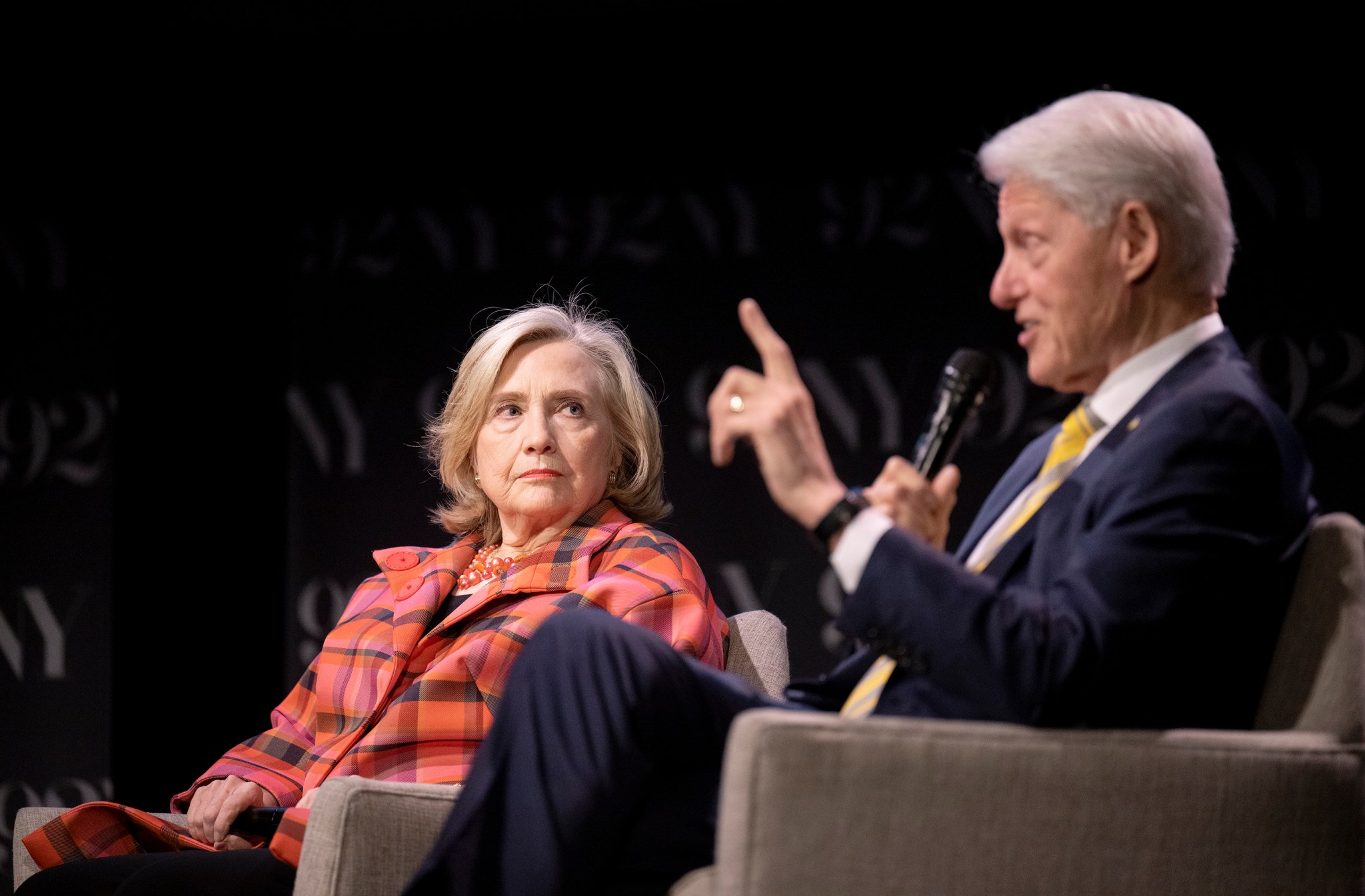
A congressional committee tasked with investigating Jeffrey Epstein recently conducted depositions with former President Bill Clinton and former Secretary of State Hillary Clinton, sessions that reportedly diverged significantly from their intended focus. After a six-month effort to secure their testimony, the House committee’s questioning, as revealed in videos released Monday, ventured into unexpected territory. Discussions reportedly included the Pizzagate conspiracy theory and inquiries about the disclosure of government information concerning unidentified flying objects (UFOs). Additionally, one session was temporarily halted due to a leaked photograph. During his testimony, former President Bill Clinton reportedly sought to distance himself from Epstein, while emphasizing the critical importance of individuals with knowledge of Epstein’s illicit activities coming forward. Conversely, former Secretary of State Hillary Clinton, during her hours of questioning, consistently maintained that she had no recollection of ever meeting Epstein, in sessions described as at times becoming contentious. These developments mark a pivotal, if unusual, moment in the ongoing congressional scrutiny of the Epstein scandal.
The House committee’s persistent efforts to depose the Clintons stem from a broader societal demand for accountability regarding Jeffrey Epstein, a financier who died by suicide in 2019 while facing federal charges for sex trafficking and abusing underage girls. His death occurred in a New York correctional facility, leaving many questions unanswered and fueling calls for a full reckoning concerning his extensive network. Globally, revelations about associations with Epstein and his former associate, Ghislaine Maxwell, have prompted numerous high-profile individuals to resign from their positions. However, within the United States, there have been comparatively few instances of severe legal repercussions for those connected to Epstein, a situation the committee aims to address. The decision to depose two of the highest-ranking former officials in U.S. history underscores the gravity and public interest surrounding the committee’s mandate to uncover the full extent of Epstein’s operations and his connections. This investigation seeks to provide clarity and justice for victims and to ensure that all relevant information is brought to light, regardless of the individuals involved.
The recently released videos from the House Oversight Committee shed light on the specific dynamics of the depositions conducted last week. According to reports, former President Bill Clinton’s testimony focused on asserting his distance from Epstein, while also delivering a clear message about the necessity for anyone possessing information pertinent to Epstein’s abuse to step forward. Meanwhile, the deposition of former Secretary of State Hillary Clinton, which spanned several hours, was characterized by her repeated assertions that she could not recall ever encountering Epstein. Sources indicate these exchanges occasionally grew heated. A notable incident occurred early in Hillary Clinton’s session when it was abruptly paused. Republican Representative Lauren Boebert reportedly transmitted a photograph of Clinton during the closed-door proceedings to a conservative influencer, who subsequently posted it online. This action constituted a violation of the committee’s established protocols for depositions and, for a period, threatened to derail the entire session, highlighting the intense political atmosphere surrounding the inquiry.
The trajectory of these high-profile depositions suggests a potential shift in the Republican-led committee’s investigative focus concerning the Clintons’ historical connections to Jeffrey Epstein and Ghislaine Maxwell. Following the conclusion of the depositions last week, there are indications that Republican lawmakers may be moving beyond their intensive scrutiny of the Clintons’ decades-old ties to the disgraced financier. The diversions into topics such as the Pizzagate conspiracy theory and inquiries about UFO disclosures, coupled with the highly publicized photo leak, suggest that the sessions may have, at times, become a platform for political spectacle rather than a singular pursuit of facts related to Epstein’s network. While the committee’s stated objective is to achieve a reckoning for Epstein’s victims, the introduction of unrelated or tangential subjects could be interpreted as diluting the investigative efforts or serving other political agendas. This development raises questions about the ultimate efficacy of these particular depositions in advancing the core mission of the Epstein inquiry and securing accountability.
In summary, the House committee’s long-anticipated depositions of former President Bill Clinton and former Secretary of State Hillary Clinton regarding Jeffrey Epstein proved to be anything but straightforward. While Bill Clinton reportedly distanced himself from Epstein and urged others to come forward with information, Hillary Clinton consistently denied any recollection of meeting him during contentious questioning. The sessions were notably sidetracked by discussions of the Pizzagate conspiracy, inquiries into government UFO information, and a protocol-violating photo leak by a Republican lawmaker. These unexpected turns, coupled with indications that Republicans may now be shifting their focus, mark a complex phase in the ongoing quest for accountability in the Epstein scandal. Moving forward, observers will be watching to see how the committee recalibrates its strategy and whether these depositions ultimately contribute substantively to the broader investigation into Epstein’s extensive network and the demand for justice.