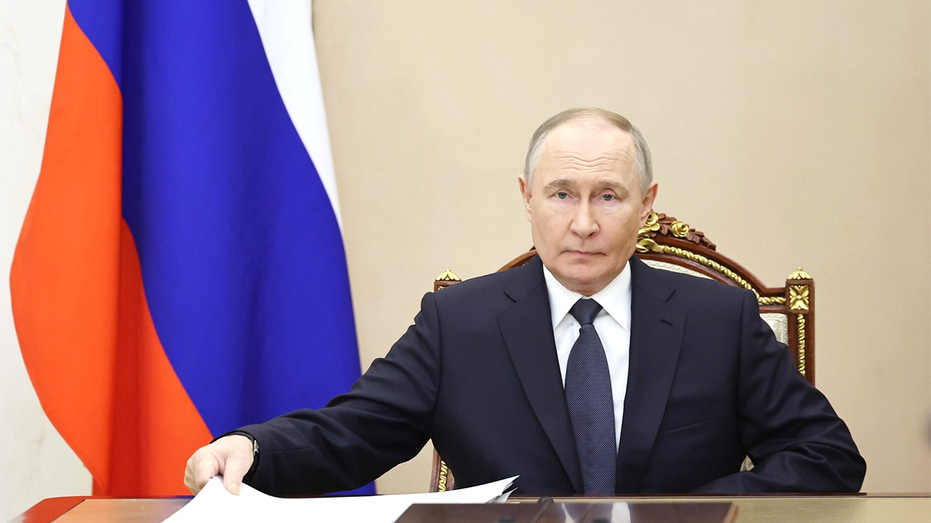
Russian President Vladimir Putin has strongly condemned the recent killing of Iranian Supreme Leader Ali Khamenei, describing the incident as a "cynical violation" of established international norms. The condemnation came on Sunday, following a series of joint strikes reportedly conducted by Israel and the United States that led to Khamenei's death. President Putin conveyed his sentiments in a formal letter addressed to Iranian President Masoud Pezeshkian, a communication that the Kremlin subsequently made public. This forceful statement from Moscow underscores the gravity of the situation and highlights the deepening geopolitical fissures emerging in the wake of the high-profile assassination, signaling a significant escalation in the ongoing tensions surrounding Iran's leadership and its regional adversaries. The timing and nature of Putin's remarks emphasize Russia's close strategic alignment with Iran and its readiness to challenge actions perceived as destabilizing the international order.
The fatal strikes, which occurred on Saturday, were characterized by reports as bold daytime operations targeting key figures within the Iranian leadership. Beyond Supreme Leader Khamenei, several other prominent Iranian officials were reportedly eliminated during these coordinated attacks, including the individual leading the Iranian Revolutionary Guard Corps (IRGC). This significant loss of top-tier leadership represents a profound blow to Iran's political and military structure, potentially ushering in a period of considerable uncertainty and internal reordering. The involvement of both the United States and Israel in these operations, as indicated by various sources, places the incident firmly within the broader context of long-standing animosities and strategic rivalries in the Middle East. These nations have consistently expressed concerns regarding Iran's nuclear ambitions, its regional influence, and its support for various proxy groups, often leading to covert operations and overt military posturing that have now culminated in this unprecedented direct action against Iran's highest authority.
In his message to President Pezeshkian, President Putin conveyed profound sorrow, stating, "Please accept my deep condolences in connection with the murder of the Supreme Leader of the Islamic Republic of Iran, Seyed Ali Khamenei, and members of his family, committed in cynical violation of all norms of human morality and international law." He further lauded the late Ayatollah Khamenei as an "outstanding statesman" who, according to Putin, made substantial personal contributions to fostering friendly Russian-Iranian relations, elevating them to a "comprehensive strategic partnership." Putin also requested that his "most sincere sympathy and support" be extended to Khamenei's family, friends, the Iranian government, and the entire Iranian populace. Concurrently, Iran's Ambassador to the United Nations, Amir-Saeid Iravani, vociferously condemned the joint U.S.-Israeli strikes during a United Nations Security Council meeting. Iravani accused the United States of undermining its stated commitment to international stability by attacking a sovereign nation over what he termed its "domestic" activities, asserting that such actions replace the "rule of law" with the "rule of force." He affirmed Iran's unwavering resolve to exercise its right to self-defense decisively until the aggression fully ceases.
The strong language employed by President Putin, particularly his characterization of Khamenei's death as a "cynical violation" of both human morality and international law, signals a significant hardening of Russia's diplomatic stance and reinforces its strategic alliance with Iran. This condemnation is likely to be interpreted as a direct challenge to the actions of the United States and Israel, potentially exacerbating geopolitical tensions in an already volatile region. Analysts suggest that Russia's unequivocal support for Iran in this crisis could further solidify the emerging anti-Western bloc, impacting global power dynamics. Ambassador Iravani's impassioned plea at the UN Security Council highlights a critical debate regarding national sovereignty versus international intervention, particularly when states cite internal matters as justification for external force. His argument that the "rule of law would be replaced by the rule of force" underscores the profound implications for international jurisprudence. Furthermore, a separate statement from former U.S. President Donald Trump, reportedly telling Iranians that the "hour of your freedom is at hand" amidst the strikes, adds another layer of complexity, suggesting a perceived broader objective by some U.S. figures beyond immediate military targets, potentially aiming for regime change.
The assassination of Supreme Leader Ali Khamenei, coupled with the swift and severe condemnation from Russia and Iran's strong stance at the United Nations, marks a critical juncture in Middle Eastern geopolitics. The incident has not only eliminated a pivotal figure in Iran's leadership but has also ignited a fierce international debate over the legality and morality of such targeted strikes. As the region braces for potential repercussions, the world will be closely watching for Iran's response, which Ambassador Iravani has indicated will involve decisive self-defense. The future of Iran's leadership, the stability of its government, and the trajectory of its foreign policy remain uncertain. Furthermore, the incident is poised to test the resilience of the strategic partnership between Russia and Iran, potentially pushing them closer together in defiance of Western pressure. The coming days and weeks will be crucial in determining the immediate aftermath and long-term implications of this unprecedented event for regional stability and international relations.