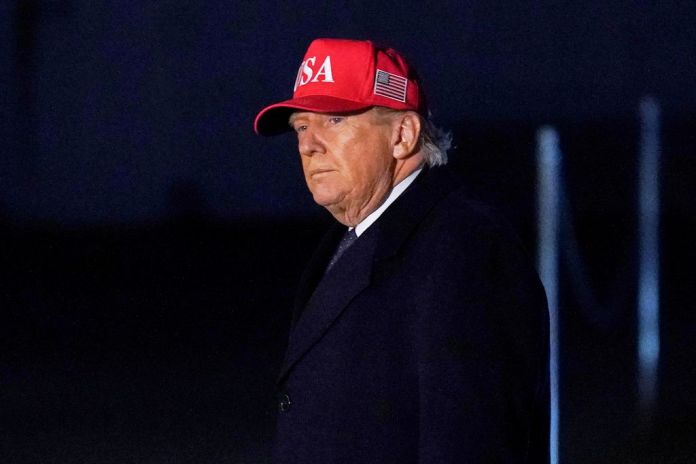
Upon his return to Washington, D.C., on Sunday evening, President Donald Trump notably refrained from engaging with reporters, sidestepping inquiries regarding the ongoing military operation in Iran. Instead of addressing the significant developments, including the death of former Supreme Leader Ali Khamenei and the reported casualties among U.S. service members, the President directed his attention to newly installed statues within the White House Rose Garden. This comes as the United States military, in conjunction with Israeli forces, has initiated an extensive military campaign against Iran over the weekend, targeting the regime’s military infrastructure. The operation, officially designated 'Operation Epic Fury,' has already resulted in the loss of three American military personnel, according to official reports, marking a critical juncture in U.S.-Middle East relations. Despite the gravity of these events, President Trump maintained a conspicuous silence on the matter when confronted by the press.
The large-scale military intervention, which commenced on Saturday, represents a dramatic escalation of tensions in the region. Reports indicate that the combined U.S. and Israeli forces have been actively engaged in striking key military assets belonging to the Iranian regime. A pivotal development in this offensive is the reported death of Ali Khamenei, Iran's former Supreme Leader, a figure whose demise carries immense geopolitical weight and could significantly alter the power dynamics within Iran and across the Middle East. The operation's codename, 'Epic Fury,' underscores the intensity and strategic importance attributed to this military endeavor by the participating nations. Such a significant military undertaking, particularly one involving the death of a prominent foreign leader and American casualties, typically prompts a direct and comprehensive address from the nation's commander-in-chief, making President Trump's recent communication strategy particularly noteworthy.
During his Sunday night return to the White House, President Trump was met by a barrage of questions from journalists eager for updates and comments on the unfolding situation in Iran. However, the President chose to disregard these appeals for a statement, opting instead to focus on the recently unveiled sculptures of Benjamin Franklin and Thomas Jefferson in the Rose Garden. According to reports, he encouraged the assembled media to observe the new additions, remarking, "Unbelievable statues, come and look at them," before departing without further comment on the military operation. This interaction aligns with the President's broader communication approach since 'Operation Epic Fury' began; he has not held a traditional press conference to announce or update the mission. Instead, initial details were shared through a video address posted on his Truth Social account, with a subsequent video update on Sunday afternoon acknowledging the service members' deaths. While officials stated that the President has engaged with some media outlets, these discussions were reportedly not recorded.
The President's decision to avoid direct engagement with the press during a major military operation, especially one involving significant casualties and the death of a former foreign leader, presents a notable shift in traditional presidential communication strategies. Observers suggest that relying primarily on social media video addresses and unrecorded conversations with select outlets, rather than formal press conferences, could have various implications. This approach might limit the opportunity for journalists to pose follow-up questions, potentially shaping the narrative more directly from the administration. Commentators often highlight the importance of presidential transparency and direct accountability during times of conflict, both for domestic reassurance and international messaging. The absence of direct, live press interaction could be interpreted differently by allies seeking clarity and adversaries attempting to gauge resolve, potentially influencing perceptions of leadership and stability during a critical period of international tension.
As 'Operation Epic Fury' continues to unfold, President Trump's communication strategy remains a key point of discussion. The ongoing military actions against Iran's infrastructure, coupled with the profound impact of former Supreme Leader Ali Khamenei's death and the tragic loss of U.S. service members, underscore the gravity of the situation. While the President has utilized his social media platform to deliver updates, the public and media continue to seek more direct and comprehensive engagement. Future developments will likely hinge on the progression of the military operation and any subsequent statements or actions from the White House, which will be closely scrutinized for insights into the administration's strategic direction and its approach to public communication during this critical international crisis.