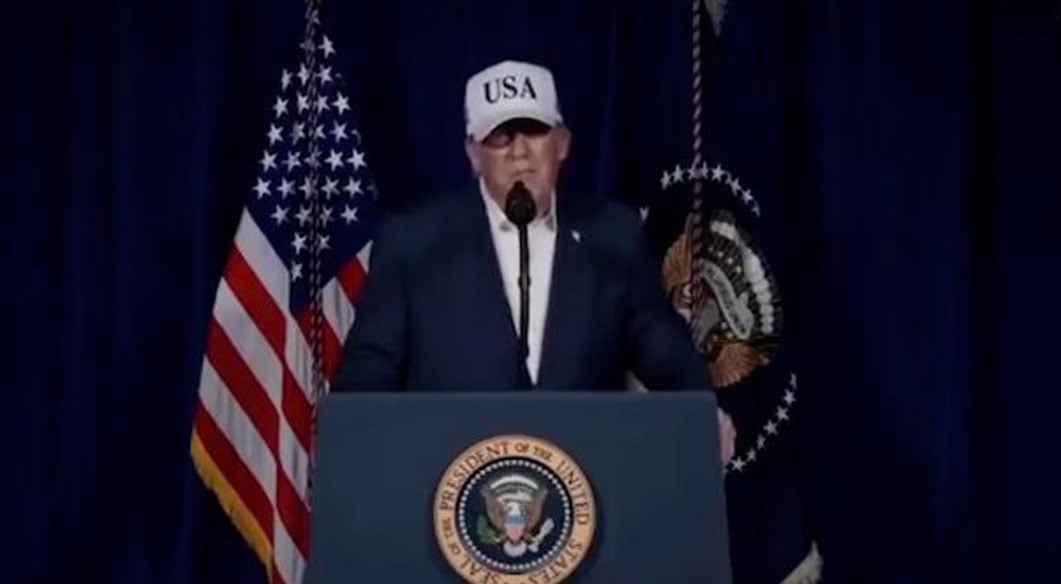
Former President Donald Trump has made a striking claim regarding the death of Iranian Supreme Leader Ayatollah Khamenei, asserting to ABC News correspondent Jonathan Karl, "I got him before he got me. They tried twice. Well I got him first." This declaration comes amidst reports of a significant military operation, categorized as "Operation Epic Fury," and follows a period of heightened tensions between the United States and Iran. The former president's remarks suggest a direct retaliatory action in response to alleged prior attempts on his life by Iranian entities. This development has also drawn criticism from Democratic circles, who, according to reports, are expressing concerns over the United States' military engagement in Iran, specifically referencing a bombing operation that preceded the leader's demise. The gravity of Trump's statement underscores the volatile nature of US-Iran relations and the potential for further escalation in the region following such a high-profile loss for Tehran.
The backdrop to this dramatic assertion is a long and fraught history between the two nations, characterized by decades of conflict and proxy warfare. For approximately 47 years, the United States has attributed numerous acts of what it describes as Iranian Islamic terror, which have reportedly resulted in substantial casualties. Official figures indicate that over 800 U.S. military personnel have lost their lives in incidents linked to Iranian aggression or its proxies, alongside an unspecified number of civilian deaths. This enduring pattern of hostility forms the critical context for understanding the recent events. The alleged attempts by Iran to assassinate Mr. Trump, mentioned in his statement, would represent a severe escalation in this historical animosity, pushing the conflict into a direct confrontation with a former U.S. head of state. Such actions, if confirmed, would undoubtedly be viewed as a profound provocation, potentially justifying a robust response from the United States, as implied by the former president's remarks.
The specifics surrounding the alleged assassination attempts on former President Trump remain largely unconfirmed by official channels beyond his own statement to Jonathan Karl. However, Trump's explicit claim that "They tried twice" before he acted suggests a calculated and direct response to perceived threats. This perspective frames the recent military action, which Democrats reportedly criticize as a bombing of Iran, as a pre-emptive or retaliatory measure. The timing of Ayatollah Khamenei's death, following these alleged attempts and the reported U.S. military engagement, paints a picture of a direct and forceful confrontation. The political fallout within the United States is also notable, with Democratic lawmakers reportedly voicing objections to the military actions, indicating a clear partisan divide on the handling of Iranian policy and the use of force in the region. These criticisms highlight the contentious nature of such operations and their potential domestic and international ramifications.
Former President Trump's candid remarks to ABC News carry significant implications for understanding the dynamics of international power and the rules of engagement. His statement, "I got him before he got me," suggests a highly personalized approach to foreign policy, where national security decisions are framed within a context of individual threats and pre-emptive retaliation. This perspective could be interpreted by some analysts as a departure from traditional diplomatic protocols, emphasizing a more direct and confrontational stance. Critics might argue that such an approach risks further destabilizing an already volatile region, potentially inviting cycles of escalation rather than de-escalation. Conversely, supporters might view it as a decisive demonstration of strength, intended to deter future aggression by adversaries. The broader implications extend to how other nations perceive U.S. foreign policy, particularly regarding the targeting of high-ranking foreign leaders and the justification for such actions based on alleged prior threats.
The death of Ayatollah Khamenei, coupled with former President Trump's unequivocal statement, marks a pivotal moment in the ongoing saga of U.S.-Iran relations. The implications of this event are far-reaching, potentially reshaping the geopolitical landscape of the Middle East and beyond. The allegations of Iranian assassination attempts on a former U.S. president, if substantiated, underscore the extreme levels of animosity that have characterized this rivalry. As the international community processes these developments, attention will undoubtedly turn to Iran's response and the potential for further retaliatory actions, as well as the stance of the current U.S. administration. The incident, framed by Trump as a pre-emptive strike, ensures that the legacy of "Operation Epic Fury" will be debated for years to come, with its full consequences yet to unfold.