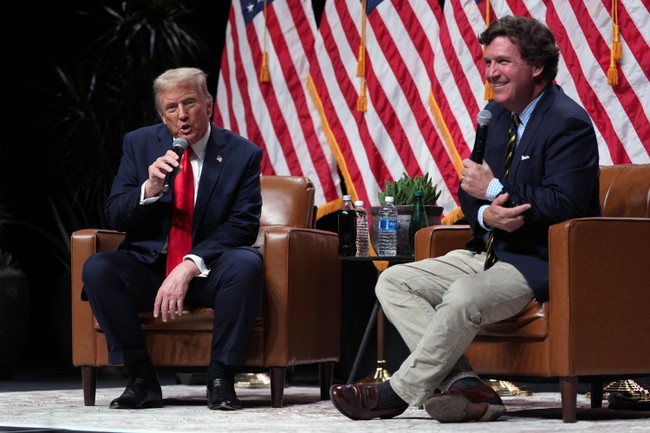
Former President Donald Trump has publicly chastised prominent conservative media personality Tucker Carlson, asserting that Carlson has 'lost his way' and does not align with the core principles of the 'Make America Great Again' (MAGA) movement. This strong rebuke, reported by ABC News correspondent Jonathan Karl following a lengthy conversation with the former president on March 5, 2026, stems directly from Carlson's recent condemnation of the ongoing conflict with Iran. Carlson had previously characterized the military action as 'absolutely disgusting and evil,' a stance that appears to have provoked a sharp reaction from Trump. The former president's comments underscore a significant public divergence between two highly influential figures within the American right-wing political landscape, signaling potential rifts on critical foreign policy matters. According to Karl's reporting, Trump explicitly stated that Carlson's views on the Iran conflict demonstrate a fundamental misunderstanding of the MAGA agenda, which Trump defines as prioritizing national salvation and America First principles.
The public disagreement between Trump and Carlson unfolds against a backdrop of escalating tensions surrounding the Iran conflict and Carlson's reported attempts to influence White House policy. Reports indicate that Carlson had made several visits to the White House earlier this year, engaging with high-level officials including former President Trump and Secretary of State Rubio. Notably, his most recent visit was specifically described as an effort to persuade Trump against initiating military action in Iran. Despite these reported direct appeals, the attack on Iran proceeded, leading to Carlson's subsequent and highly public denunciation of the war, which he articulated to Jonathan Karl on February 28, 2026. This sequence of events highlights the intricate dynamics between media influence, internal political counsel, and the ultimate decisions made by executive leadership, particularly on matters of international conflict. The clash is significant given Carlson's substantial following among conservative voters, many of whom also form Trump's base, making this a notable internal challenge to the former president's foreign policy positions.
In his extensive conversation with Jonathan Karl, former President Trump did not mince words regarding his assessment of Tucker Carlson's political alignment and intellectual capacity. Trump explicitly stated, 'Tucker has lost his way,' adding that he had recognized this 'a long time ago.' He further elaborated on his belief that Carlson is 'not MAGA,' defining the movement as dedicated to 'saving our country,' 'making our country great again,' and embodying 'America first' principles. According to Trump, Carlson embodies 'none of those things,' and went on to suggest that Carlson is 'really not smart enough to understand that.' This pointed critique from Trump directly counters Carlson's public condemnation of the Iran war, which he had labeled 'absolutely disgusting and evil.' The former president's remarks, as reported by Karl, leave little room for ambiguity regarding his perception of Carlson's deviation from what he considers the true MAGA ideology, especially concerning a major military engagement that has drawn significant debate.
This public spat between Donald Trump and Tucker Carlson carries substantial implications for the conservative movement and the broader political discourse. Analysts suggest that such a high-profile disagreement on a critical foreign policy issue like the Iran war could expose deeper ideological fissures within the 'America First' coalition. While both figures command significant influence among right-leaning voters, their divergent views on military intervention could force their respective followers to choose sides or grapple with internal inconsistencies. Observers note that Carlson's willingness to openly criticize a military action potentially initiated or supported by Trump, even after reportedly attempting to dissuade him privately, marks a bold move for a figure often seen as an ally. This incident could signal a shift in the landscape of conservative media, where even staunch supporters of the former president might feel empowered to voice dissent on specific policies, particularly those involving military engagements abroad. The long-term impact on both Trump's political standing and Carlson's media career remains a key point of speculation.
The recent exchange between Donald Trump and Tucker Carlson represents a notable fracture within the conservative media and political establishment, centered on the contentious issue of the Iran war. Trump's assertion that Carlson has 'lost his way' and is not genuinely aligned with the MAGA movement, directly countering Carlson's 'disgusting and evil' characterization of the conflict, highlights a significant ideological divide. This public disagreement, reported by Jonathan Karl, underscores the complexities of maintaining unity within a broad political coalition, especially when faced with high-stakes foreign policy decisions. Moving forward, political observers will be watching closely to see how this rift impacts the internal dynamics of the Republican party, the influence of conservative media figures, and the ongoing debate surrounding America's role in international conflicts. The incident serves as a potent reminder that even powerful alliances can be tested by fundamental disagreements on policy and principle.