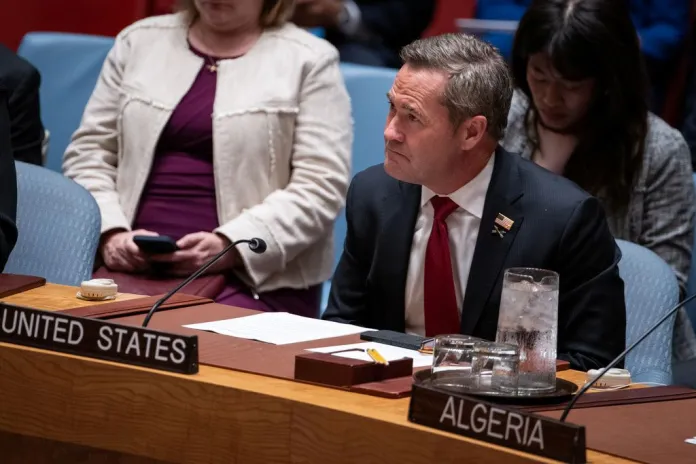
At an urgent session of the United Nations Security Council held on Saturday, the United States vigorously defended its recent military actions targeting Iran's ballistic missile and nuclear development facilities. U.S. Ambassador to the UN, Mike Waltz, articulated the American position, asserting that these operations were entirely lawful and necessary to counter what he described as a severe and escalating threat posed by Tehran's persistent pursuit of advanced missile capabilities and its refusal to abandon nuclear ambitions. Waltz emphasized that preventing Iran from acquiring nuclear weapons is a matter of global security, transcending political considerations. This stance, however, met with sharp disagreement from the UN Secretary-General Antonio Guterres and several other member states, who raised serious concerns regarding the adherence to international legal frameworks by both the United States and Israel in their recent military engagements within the region. The emergency meeting underscored the deep international divisions over the escalating tensions and military actions in the Middle East, highlighting the precarious balance between national security interests and global legal norms.
The backdrop to these contentious discussions is a long-standing international concern over Iran's strategic military programs, particularly its advancements in ballistic missile technology and its nuclear enrichment activities. For years, the international community has grappled with diplomatic efforts aimed at curbing these programs, often through multilateral agreements and sanctions. According to U.S. and Israeli officials, Iran's continued development in these areas, coupled with what they perceive as a lack of transparency and a refusal to engage constructively in diplomatic resolutions, has created an intolerable security risk. This perceived intransigence has fueled a narrative among certain nations that more assertive measures are required to prevent a regional power from acquiring capabilities that could destabilize an already volatile Middle East. The current military actions, therefore, are presented by their proponents as a direct response to a perceived failure of diplomatic avenues and a necessary step to preempt a greater future danger, framing the strikes as a critical intervention to maintain regional and global stability.
During the Security Council's emergency gathering, Ambassador Waltz explicitly stated that Iran's ongoing pursuit of sophisticated missile technology, combined with its unwillingness to relinquish its nuclear aspirations despite numerous diplomatic opportunities, represents a profound and growing peril. He underscored that the principle of denying Iran a nuclear weapon is not a political issue but a fundamental matter of global security, thereby justifying the United States' 'lawful actions.' This rationale was strongly supported by Israel, which also disclosed its own military operations targeting Iranian leadership, including reports of the death of Supreme Leader Ali Khamenei. Israel's U.N. Ambassador Danny Danon articulated his nation's resolve, stating, "We are stopping extremism before it becomes unstoppable," and affirmed their commitment to preventing any radical regime armed with nuclear weapons and ballistic missiles from threatening their populace or the wider world. In stark contrast, U.N. Secretary-General Antonio Guterres, alongside other nations on the Security Council, voiced profound disagreement. Guterres specifically asserted that both the U.S. and Israeli actions constituted violations of international law. He also condemned Iran's subsequent retaliatory attacks against various nations across the Middle East, urging both Washington and Tehran to re-engage in diplomatic negotiations to avert a broader conflict that could have severe repercussions for civilians and regional stability.
The divergent interpretations of international law presented at the Security Council meeting highlight a significant challenge to global governance and stability. On one side, the United States and Israel assert a right to preemptive self-defense against what they characterize as an existential threat, citing Iran's alleged non-compliance with international norms and its destabilizing regional activities. This perspective often emphasizes the sovereign right of nations to protect their security interests when diplomatic solutions are perceived to have failed. On the other side, the UN Secretary-General and several member states underscore the paramount importance of adhering to established international legal frameworks, including the prohibition on the use of force without Security Council authorization or clear self-defense justification. The accusation that both the U.S. and Israel violated international law, coupled with the condemnation of Iran's retaliatory strikes, suggests a deeply fractured international consensus on the legitimate use of force. This fundamental disagreement risks further eroding the authority of international institutions and could embolden various actors to pursue unilateral military actions, potentially leading to an unpredictable escalation of hostilities across the Middle East, with dire humanitarian and geopolitical consequences. The reported death of a key leader like Supreme Leader Ali Khamenei, if confirmed, could also introduce significant uncertainty into Iran's political landscape, potentially altering its future trajectory and regional posture.
In conclusion, the emergency UN Security Council meeting revealed a deeply polarized international community grappling with escalating tensions in the Middle East. While the United States and Israel maintain that their recent strikes on Iran's military infrastructure and leadership were lawful and necessary to safeguard global security against a nuclear threat, the United Nations Secretary-General and several other nations vehemently contend that these actions contravened international law. This fundamental disagreement over the legality of military interventions, coupled with Guterres's stern warning of a potential wider conflict, underscores the urgent need for de-escalation and renewed diplomatic engagement. The immediate future hinges on whether the involved parties can be persuaded to return to the negotiating table, thereby averting a potentially catastrophic regional conflagration. Observers will be closely monitoring any further military actions, diplomatic overtures, and the internal political ramifications within Iran following these significant developments.