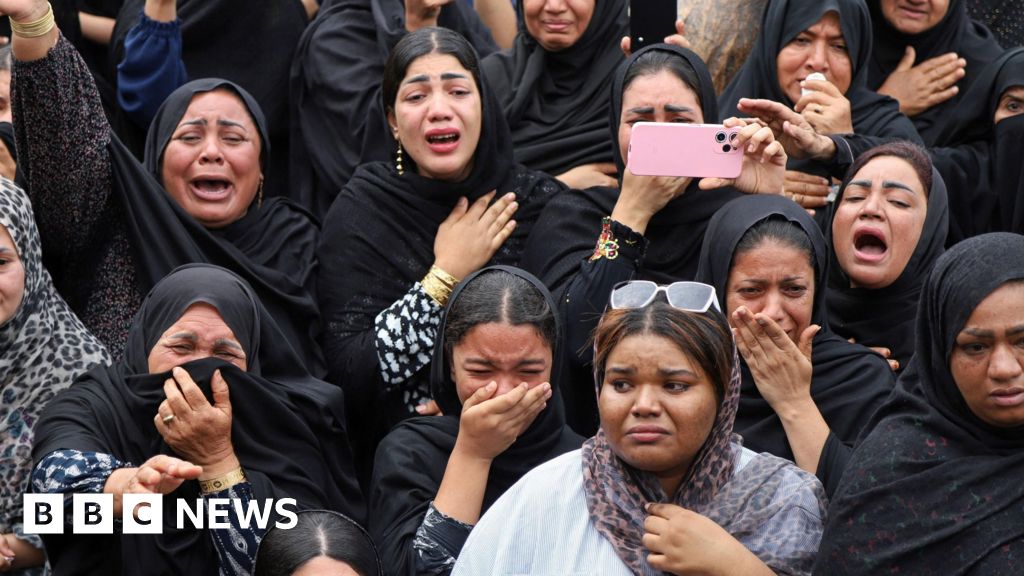
Mourners gathered in southern Iran to commemorate students and staff members who, according to Iranian authorities, lost their lives in a recent military action. Officials in Tehran have attributed the devastating incident, which reportedly struck a girls' school in the city of Minab on Saturday, to a joint US-Israeli operation. These claims suggest the school was hit amidst a broader series of strikes allegedly launched by the United States and Israel, targeting various Iranian military installations and leadership positions. Iranian sources indicate that the attack resulted in over 160 fatalities. However, independent confirmation of this casualty figure has not yet been possible. In response to these grave allegations, the United States military has stated it is actively investigating the reports of the incident, while Israeli defense forces have indicated no awareness of any operational activities in that specific region. The solemn funerals, widely broadcast on Iranian state television, underscored the profound grief following the alleged assault.
The alleged strike on the Minab school unfolds against a backdrop of heightened regional tensions, with Iranian officials consistently asserting that the United States and Israel have been engaged in extensive military actions aimed at key Iranian strategic assets and command structures. According to these reports, the incident occurred on a Saturday, a regular school day in Iran's six-day working week, meaning the educational facility was likely populated with students and faculty at the time of the impact. The school's location, approximately 600 meters (about 1,970 feet) from a base belonging to the Islamic Revolutionary Guard Corps (IRGC), adds a critical layer of complexity to the narrative. While Iranian authorities frame the proximity as evidence of a deliberate targeting of a civilian site, the presence of a military installation nearby could also be a factor in the broader strategic context of the alleged wider strikes. This proximity has been a recurring theme in similar incidents in conflict zones, often complicating efforts to ascertain the precise intent and nature of military engagements.
The emotional weight of the alleged attack was palpable during the funeral ceremonies, which saw hundreds of grieving individuals line the streets of Minab. Iranian state television extensively covered the processions, showcasing coffins draped in the national flag of the Islamic Republic being carried through dense crowds. A poignant voiceover during the broadcast conveyed the immense sorrow of parents who had lost their daughters, emphasizing the human toll of the claimed strike. Iranian officials provided further details regarding the alleged assault, asserting that the school was impacted by three missiles during the morning hours of Saturday. President Masoud Pezeshkian of Iran vehemently condemned the event, characterizing it as a "barbaric act" and labeling it "another black page in the record of countless crimes committed by the aggressors." This strong rhetoric from the highest levels of Iranian leadership underscores the severity with which Tehran views the incident, even as international bodies and other nations grapple with the challenge of verifying the claims.
The unverified claims surrounding the Minab school strike present a significant challenge for international observers and could have far-reaching implications for regional stability. Should the allegations of a US-Israeli strike on a civilian educational facility prove true, it would represent a severe escalation of hostilities and a potential violation of international humanitarian law, drawing widespread condemnation. Conversely, if the claims are found to be unsubstantiated or if the target was indeed the nearby IRGC base with unintended civilian casualties, it highlights the inherent dangers of military operations in populated areas. The immediate denial of awareness from Israel and the US military's stated investigation underscore the sensitive nature of such accusations and the difficulty in obtaining clear, impartial information in highly charged geopolitical environments. For Iran, the incident, regardless of its verified details, serves as a powerful narrative tool, galvanizing public sentiment and reinforcing its stance against perceived foreign aggression, potentially complicating any future de-escalation efforts. The lack of independent verification leaves a critical information vacuum, allowing competing narratives to flourish and potentially fueling further distrust and animosity.
In summary, the tragic events in Minab, marked by funerals for over 160 claimed victims, have ignited a fierce diplomatic and informational dispute. Iranian authorities firmly attribute the destruction of a girls' school to a US-Israeli strike, a claim that has yet to be independently substantiated. While the United States is reportedly investigating, Israel has denied any operational involvement in the area. The incident, occurring near an IRGC base, has been met with strong condemnation from Iranian leadership, who portray it as a barbaric act. The profound human cost, as depicted during the state-televised funerals, underscores the urgency for clarity and accountability. As the international community awaits further details and potential independent verification, the allegations risk further exacerbating already volatile regional tensions, making the pursuit of factual accuracy paramount in the coming days.