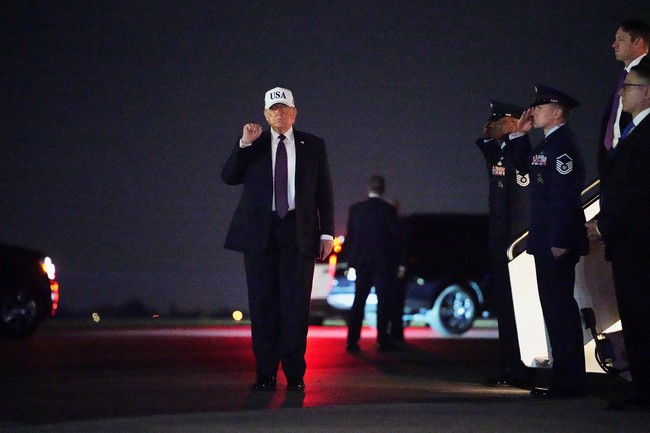
Former President Donald Trump publicly reacted to the reported death of Iran's Supreme Leader, Ayatollah Ali Khamenei, on Saturday afternoon, attributing his demise to coordinated military strikes conducted by the United States and Israel. Posting on Truth Social, President Trump characterized Khamenei as among the most malevolent figures in history, confirming earlier Israeli accounts of the Iranian leader's passing. He articulated that this outcome represented a form of justice not only for the Iranian populace but also for Americans and individuals globally who, according to his statement, had suffered fatalities or mutilations at the hands of Khamenei and his associates. Concurrently, as these developments unfolded, the United Nations Security Council convened in New York City, where UN Secretary General António Guterres issued a strong condemnation of the military actions undertaken by the U.S. and Israel, emphasizing the paramount importance of upholding international law and humanitarian principles.
This significant development unfolds against a backdrop of deeply entrenched geopolitical tensions, falling under the operational designation of 'Operation Epic Fury.' The relationship between the United States, Israel, and Iran has been fraught with hostility for decades, marked by proxy conflicts, sanctions, and accusations of state-sponsored terrorism. Ayatollah Khamenei, who succeeded Ayatollah Ruhollah Khomeini in 1989, had served as Iran's Supreme Leader for over three decades, wielding ultimate authority over the country's religious, political, and military affairs. His leadership saw Iran develop its nuclear program, expand its regional influence through various proxy groups, and maintain a staunch anti-Western stance. The reported involvement of both American and Israeli forces in the strikes leading to his death signals a dramatic escalation in this long-standing rivalry, potentially reshaping the power dynamics across the entire Middle East and introducing profound uncertainty regarding Iran's immediate future and its role on the global stage.
In his extensive statement, President Trump elaborated on the circumstances surrounding Khamenei's death, asserting that the Iranian leader was unable to evade the advanced intelligence and highly sophisticated tracking systems employed by the allied forces. He further indicated that, working in close collaboration with Israel, neither Khamenei nor other leaders reportedly killed alongside him could escape the precision of these operations. The former Commander-in-Chief also revealed that what he termed "heavy and pinpoint bombing" would persist throughout the week, or for as long as deemed necessary, to achieve the stated objective of fostering "PEACE THROUGHOUT THE MIDDLE EAST AND, INDEED, THE WORLD!" These declarations underscore a resolute and aggressive posture towards Iran, aiming to dismantle its leadership structure and influence. Conversely, the UN Secretary General's remarks at the Security Council meeting served as a stark reminder of the international community's concerns regarding the legality and humanitarian implications of such military interventions, stressing that adherence to international law must always be paramount.
The ramifications of Ayatollah Khamenei's death, particularly under these circumstances, are poised to be far-reaching and complex. Analysts suggest that while his demise could create a significant power vacuum within Iran, potentially leading to internal struggles for succession, it might also galvanize hardline elements or provoke retaliatory actions. The continuation of "heavy and pinpoint bombing," as outlined by President Trump, signals an intent to exert sustained pressure on the Iranian regime, which could further destabilize an already volatile region. Experts on international law are likely to scrutinize the legality of these strikes, especially given the UN Secretary General's condemnation, raising questions about sovereignty and the use of force without explicit UN authorization. This event could fundamentally alter the trajectory of U.S. foreign policy towards Iran, particularly if President Trump were to return to office, potentially ushering in an era of more direct confrontation rather than diplomatic engagement, with unpredictable consequences for global security.
In summary, the reported death of Ayatollah Ali Khamenei, attributed by former President Trump to US-Israeli military strikes, marks a pivotal moment in the ongoing geopolitical tensions surrounding Iran. While President Trump hailed the event as a triumph of justice and called for continued military action to achieve regional peace, the United Nations swiftly condemned the strikes, underscoring the critical importance of international law. The immediate aftermath is likely to be characterized by intense scrutiny of Iran's internal power dynamics, potential retaliatory measures, and heightened regional instability. The international community will be closely watching for any shifts in Iran's leadership, the extent and duration of the announced bombing campaign, and the broader implications for peace and security in the Middle East and beyond, as the full impact of these dramatic developments begins to unfold.