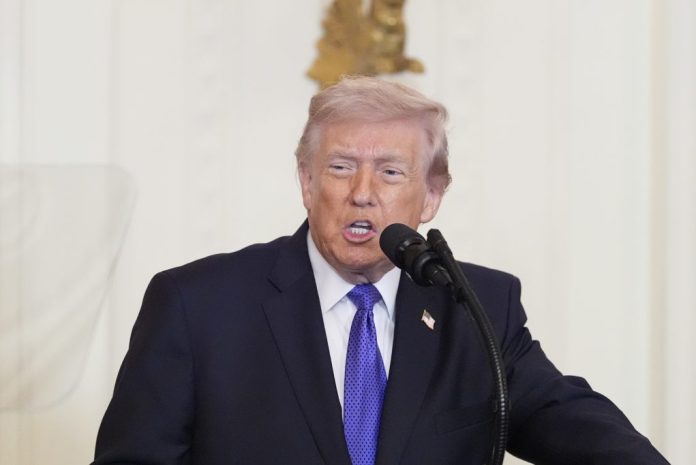
Former President Donald Trump has announced his intention to participate in the upcoming White House Correspondents' Association (WHCA) dinner, an event scheduled for April 25. This decision represents a notable departure from his previous stance, as it will be the first instance of the former commander-in-chief attending the annual gathering during his time in office, according to recent reports. The WHCA dinner, a long-established tradition within Washington D.C. circles, serves as a prominent platform where journalists, political figures, and various public personalities convene to honor the vital role of the press and to generate financial support for journalism scholarships. Trump's choice to accept the invitation breaks a pattern of consistent boycotts that had characterized his administration's often strained interactions with news organizations. Observers are suggesting that this participation could either signal a new phase in the dynamic between the executive branch and the press corps or simply represent a calculated strategic maneuver in anticipation of forthcoming political cycles.
The White House Correspondents' Association dinner boasts a rich historical lineage, tracing its origins back to 1921, and has traditionally functioned as a distinctive forum for the President to engage directly with the journalists who meticulously cover the executive branch on a daily basis. Throughout much of its history, presidents have utilized this occasion for lighthearted, self-deprecating humor and engaging, witty exchanges with members of the press, frequently featuring a professional comedian as the primary entertainer. However, the overall tone and format of the event have undergone significant transformations, particularly in more recent years. President Trump notably chose to abstain from attending the dinner in 2017, 2018, and 2019, consistently citing his profound disagreements with what he often labeled 'fake news' and his perception of biased or unfair media coverage. His repeated absence prompted the WHCA to re-evaluate the event's structure, leading to a decision in 2019 to feature a historian instead of a comedian, with the explicit aim of re-emphasizing the fundamental importance of a free press and the First Amendment. This backdrop of non-attendance and public criticism of the media provides essential context for comprehending the potential implications of his announced presence this year.
The former president's relationship with the media during his tenure was frequently characterized by open antagonism and sharp criticism, with numerous instances of him publicly denouncing news outlets and individual journalists. Given this history, his decision to attend the WHCA dinner is viewed by many as particularly significant. The event itself brings together a diverse array of attendees, including the very journalists Trump has often criticized, alongside members of Congress, cabinet officials, and other influential public figures, all under one roof. Traditionally, the dinner is a moment for presidents to showcase a lighter side, engaging in banter and acknowledging the press's role, even amidst political disagreements. Reports indicate that the WHCA's invitation was extended "very nicely," suggesting a mutual desire for a more conventional interaction. This shift could be interpreted as a gesture of conciliation, or, as some analysts suggest, a pragmatic move to project an image of engagement and accessibility ahead of potential future political campaigns, allowing him to control a narrative that has long been dominated by his past boycotts.
Analysts and political commentators are offering varied perspectives on the implications of this unexpected attendance. Some experts suggest that Trump's participation could signify a strategic attempt to soften his image or to appear more presidential and engaged with established Washington traditions, particularly as he remains a prominent figure in national politics. Others view it as a calculated political maneuver, designed to generate media attention on his terms and potentially to use the platform to deliver a message directly to a captive audience of journalists and political elites. The event's historical context, where presidents often deliver humorous remarks, raises questions about the tone Trump might adopt. Will he maintain his characteristic confrontational style, or will he embrace the tradition of lighthearted self-deprecation? The choice of approach could either signal a genuine, albeit temporary, truce with the press or reinforce existing tensions, making the event a focal point for observing the evolving dynamics between political power and media scrutiny.
In conclusion, Donald Trump's decision to attend the White House Correspondents' Association dinner marks a significant and unprecedented moment, breaking a pattern of boycotts that defined his previous interactions with the press during his presidency. This move, announced for the April 25 event, prompts considerable speculation regarding its underlying motivations and potential outcomes. Whether it signals a genuine shift towards a more conventional engagement with the media, a strategic political calculation, or merely a temporary deviation from his established approach, the event is poised to draw intense scrutiny. Observers will be closely watching for the tone and content of his remarks, as well as the broader reception, to discern any lasting implications for the often-contentious relationship between the executive branch and the news media in the current political landscape.