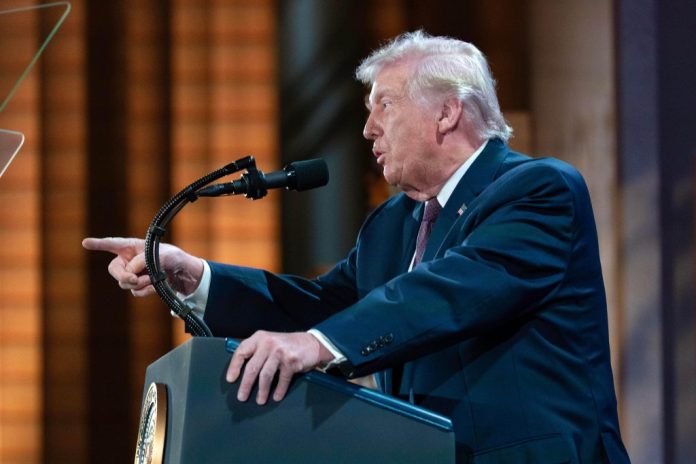
Former President Donald Trump is slated to make a highly anticipated return to the White House Correspondents’ Association (WHCA) annual dinner on April 25, 2026, marking his first attendance at the event as the nation's commander-in-chief. This appearance holds particular significance, occurring fifteen years after a pivotal 2011 gathering where then-President Barack Obama publicly ridiculed Trump, then a prominent businessman. That earlier incident, featuring pointed jokes about Trump's "birther" claims and other conspiracy theories, is widely regarded by media observers and political commentators as a potential catalyst that ignited Trump's eventual presidential ambitions. The upcoming dinner now offers a unique and highly visible platform for Trump to directly engage with the assembled members of the press, a collective he has consistently and vociferously criticized, often labeling their reporting as "Fake News." Political strategists are already anticipating a confrontational evening, with Republican strategist Ford O’Connell suggesting that Trump will likely "roast the press," indicating a deliberate departure from the event's traditional, albeit often humorous, civility. This return to the WHCA stage is poised to be a defining moment, potentially reshaping the traditional dynamic between the presidency and the press corps in an era of heightened media scrutiny and political polarization.
The historical backdrop to Trump’s impending return to the WHCA dinner is crucial for understanding its potential impact. The 2011 event saw then-President Barack Obama deliver a series of sharp, comedic jabs directed squarely at Donald Trump, who was present in the audience. Obama’s remarks notably targeted Trump’s persistent questioning of Obama’s birth certificate, a conspiracy theory Trump had actively promoted. The former president humorously suggested that with the birth certificate matter settled, Trump could now focus on other pressing inquiries, such as the authenticity of the moon landing, events in Roswell, and the whereabouts of musical icons Biggie and Tupac. Reports from the time indicate that Trump remained conspicuously silent throughout Obama’s routine, enduring the laughter of the assembled crowd at his expense. This public humiliation, according to widely circulated media lore, served as a profound turning point, solidifying Trump’s resolve to seek the highest office in the nation. The incident underscored the long-standing, complex relationship Trump has maintained with the media, characterized by both engagement and fervent criticism, a dynamic that has evolved over several decades and continues to define his public persona.
The upcoming WHCA dinner is expected to provide a highly visible forum for President Trump to articulate his long-held grievances against various news organizations. Throughout his political career, and particularly during his previous presidency, Trump consistently employed the label "Fake News" to dismiss reporting he deemed unfavorable or inaccurate, fostering an environment of deep distrust between his administration and many journalistic outlets. This consistent rhetoric has set the stage for what many observers anticipate will be a candid and potentially unvarnished address. Republican strategist Ford O’Connell explicitly stated his expectation that Trump will use the platform to "roast the press," indicating a deliberate and pointed critique rather than a lighthearted exchange. Another GOP strategist, Matt Dole, offered an even more direct assessment, highlighting Trump’s decades-long "love-hate relationship" with the media. Dole further suggested that Trump anticipates a challenging evening himself, which, in turn, implies he will feel no compunction about "sharing what he really feels about the press corps." The fifteen-year interval since the 2011 dinner, where Trump was the subject of presidential mockery, now positions him as the one holding the microphone, creating a dramatic shift in the power dynamic and offering an opportunity for a perceived reckoning.
The impending return of Donald Trump to the White House Correspondents’ Association dinner carries significant implications for both the institution of the presidency and the role of the press. Expert observers suggest that this event could transcend its traditional function as a lighthearted gathering, potentially transforming into a highly charged political spectacle. Trump's history of direct confrontation with media organizations, coupled with his willingness to challenge established norms, indicates that his address may be less about comedic relief and more about a strategic assertion of his perspective on journalism. This could further exacerbate the already strained relationship between the executive branch and the Fourth Estate, potentially setting a new precedent for how presidents engage with the press corps at such public forums. The broader implications extend to the very nature of political discourse, as Trump's anticipated remarks could reinforce his base's skepticism towards mainstream media while simultaneously drawing sharp criticism from those who advocate for a free and independent press. His presence, particularly given the historical context of the 2011 dinner, symbolizes a full-circle moment, where a figure once ridiculed by the establishment now commands the stage, potentially using it to settle old scores and redefine the boundaries of presidential-media interactions. This event will serve as a barometer for the ongoing tension and the evolving dynamics of power and accountability in contemporary American politics.
In summary, Donald Trump’s upcoming appearance at the White House Correspondents’ Association dinner on April 25, 2026, is far more than a routine presidential engagement; it is a moment steeped in historical context and charged with political anticipation. His return, fifteen years after being the target of President Obama’s pointed humor, offers a unique platform for a figure known for his direct challenges to the media. Strategists widely expect Trump to use this opportunity to express his long-standing criticisms of the press, potentially leading to a confrontational evening. The event will undoubtedly be closely watched for how Trump leverages the stage, the media's reaction to his remarks, and the broader implications for the future of presidential-press relations. This dinner is poised to be a significant chapter in the ongoing narrative of media scrutiny, political rhetoric, and the evolving relationship between power and accountability in the American public sphere.