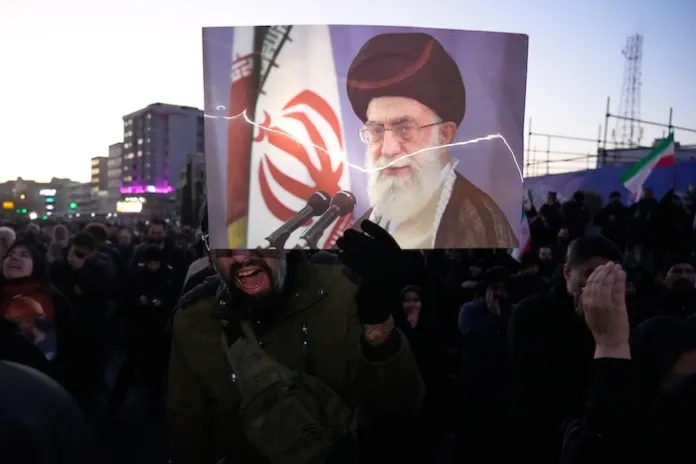
In a dramatic turn of events, Iranian authorities have confirmed the formation of a three-member interim council tasked with governing the nation, following what officials describe as unprecedented joint operations by the United States and Israel. These coordinated actions reportedly led to the elimination of Supreme Leader Ali Khamenei and numerous other high-ranking officials. The newly appointed council, established in accordance with the country's constitutional provisions, comprises Iranian President Masoud Pezeshkian, the chief justice of the Supreme Court, Gholam-Hossein Mohseni-Ejei, and Ayatollah Alireza Arafi, a prominent member of the Guardian Council. This swift establishment of temporary leadership comes in the wake of a significant military offensive on Saturday morning, which has plunged the Islamic Republic into a period of profound political uncertainty and raised urgent questions about its future direction.
The sudden demise of Supreme Leader Ali Khamenei marks a pivotal moment in Iran's modern history, as he had steered the nation since his appointment in 1989. His ascension to power followed the passing of Ayatollah Ruhollah Khomeini, the founder of the Islamic Republic, who served as Supreme Leader from the 1979 revolution until his death. Khamenei's appointment was made by the Assembly of Experts, an influential 88-member clerical body constitutionally empowered to select and oversee the Supreme Leader. This assembly has only exercised its succession authority once before, making its current task of identifying a new spiritual and political head of state an exceptionally rare and critical undertaking. The unprecedented nature of the recent U.S.-Israeli operations, which targeted and eliminated such a high echelon of Iranian leadership, underscores the gravity of the situation and the immense pressure now facing the Assembly of Experts.
Details emerging from the operations on Saturday morning paint a picture of a highly coordinated and effective strike. According to reports, the offensive constituted the 'opening salvo' of a broader conflict, resulting in the deaths of dozens of senior Iranian figures. Israeli military intelligence director Shlomi Binder stated that the forces were "able to create tactical surprise, eliminating over 40 of the most important individuals in Iran in under 40 seconds." This remarkable speed and precision highlight the sophisticated planning and execution behind the operation, which effectively decapitated a significant portion of Iran's political and military command structure. The loss of so many key leaders, including the Supreme Leader himself, within such a brief timeframe represents an unparalleled blow to the Islamic Republic's institutional stability and decision-making capacity.
The immediate implications of these events are far-reaching, both domestically and internationally. The Assembly of Experts now faces the monumental challenge of selecting a successor to Khamenei, a process fraught with potential for internal power struggles and factionalism within Iran's clerical establishment. The selection of a new Supreme Leader is not merely a ceremonial act but determines the ideological and strategic trajectory of the nation. Furthermore, the specter of continued external intervention looms large; sources indicate a significant concern that any newly appointed successor could become a direct target for subsequent Israeli or U.S. military actions. This ongoing threat environment could severely complicate the succession process, potentially leading to a leadership vacuum or a prolonged period of instability as various factions vie for control under intense scrutiny and external pressure. The broader geopolitical ramifications for regional stability and global energy markets are also profound, as a destabilized Iran could trigger wider conflicts.
As the interim council assumes its duties, the immediate focus will undoubtedly be on managing the day-to-day affairs of the state while the Assembly of Experts deliberates on the crucial matter of succession. The coming weeks will be critical in determining Iran's path forward, with the world watching closely for signs of internal cohesion or fragmentation. The unprecedented nature of the recent operations and the subsequent leadership void suggest a period of heightened uncertainty and potential volatility. The selection of a new Supreme Leader, the response from regional and international actors, and the potential for further military engagements will be key indicators to monitor as Iran navigates this profoundly challenging and transformative period in its history.